
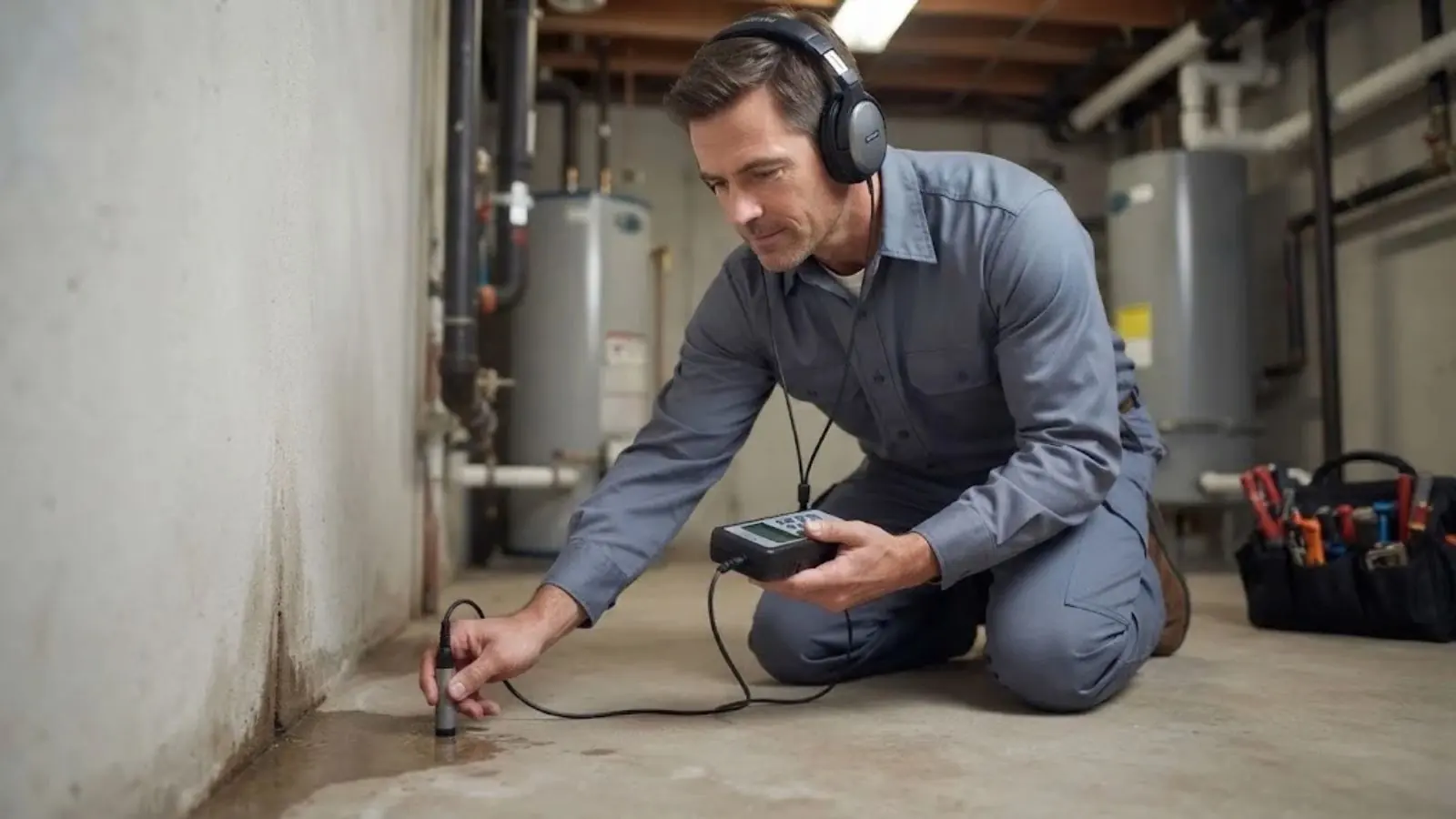
If your water meter keeps spinning with every tap closed, or a ceiling stain is growing, you have a leak and each hour matters. Our 24/7 emergency line sends licensed plumbers for leak detection in Lafayette, CA, and while you wait you can shut off the main valve, switch off power to wet areas and read the meter.
Most leaks are not dramatic. They hiss inside a wall, drip under a floor or seep from a buried pipe for weeks before anyone notices a higher water bill. Finding the exact spot is the hard part, and it decides whether the repair is a small patch or a torn-up room.
This page walks through the symptoms, the free meter test you can run yourself, the tools a plumber uses to pinpoint the pipe, and what to expect when we come out. Once the leak is found, the repair itself follows the California Plumbing Code, which is based on the Uniform Plumbing Code (UPC), so a patched pipe goes back to the standard a plumbing inspector would expect.
Water where it should not be: do this first
Active water in a ceiling, a light fixture or near an outlet is a shock risk. Keep people out of the room before you touch anything else.
- Turn off the main water shutoff, usually at the front of the house, by the water heater, or in the garage.
- Switch off breakers for any room with a wet ceiling, wall or floor. Do not stand in water to reach the panel.
- Open a low faucet to drain pressure from the pipes, then move valuables and rugs out of the wet area.
- If the leak is near a gas appliance and you smell gas, leave the house and call 911 first, then PG&E at 1-800-743-5000.
What your house is telling you: symptoms and likely causes
Hidden leaks leave clues long before water pools. Match what you see or hear to the most likely source, then use the meter test below to confirm.
Meter moves with everything off
Water is leaving somewhere. The meter test separates a leak in the yard line from one inside the house.
Bill jumped, habits did not
A steady leak runs all day and night, so the bill climbs even if nobody changed how they use water.
Stain, bubble or sag on a ceiling or wall
Paint that blisters or drywall that feels soft usually means a supply or drain line behind it is wet.
Warm or damp spot on the floor
A warm patch under tile or wood often marks a hot line leaking beneath the floor. See slab leak repair if the house sits on concrete.
Low pressure or a hiss at night
A quiet hiss when the house is silent points to a pressurized pipe. If it turns into spraying or flooding, see burst pipe repair.
Musty smell or new mold
Constant moisture grows mold fast. A smell with no visible source often means a wet cavity you cannot see.
Run the EBMUD meter and houseline test
This test takes about an hour, costs nothing and tells you which side of the house to look at. Use only the steps below, and do not open or tamper with the meter itself.
- Turn off every tap, appliance and sprinkler, inside and outside. Make sure the dishwasher, washer and ice maker are not running.
- Find the meter, usually in a concrete box near the curb with the EBMUD logo on the lid. Lift the lid carefully and look at the leak indicator, often a small triangle or dial.
- If the indicator is moving with all water off, there is likely a leak. If it is still, do a pin test: mark the dial position with a toothpick, a pin or a photo, wait 30 minutes without using water, then check again.
- To split the house from the yard, close the houseline valve, the shutoff on the line running to the house. Mark the dial and wait 30 minutes.
- If the dial moved with the houseline valve closed, the leak is likely in the pipe between the meter and the house, so call a plumber. If it did not move, the leak is likely inside the home.
EBMUD is responsible for leaks on the street side of the meter, including the meter and its threads. You are responsible for leaks and repairs on the customer side. If you see water leaking on EBMUD's side, call EBMUD Emergency Dispatch at 1-866-403-2683 and press 1. EBMUD's own page explains the process: EBMUD guide for leaks and high bills.
How plumbers pinpoint a leak without opening the wall
The goal is a marked spot on the floor or wall, so any repair opens only what it must. Different tools answer different questions, and a good visit usually combines two or three.
| Method | What it finds | Best used for |
|---|---|---|
| Acoustic listening device. | The sound of water escaping a pressurized pipe. | Slab, buried and in-wall supply lines. |
| Thermal imaging camera. | Temperature differences from wet or hot-water paths. | Ceilings, walls, radiant heat floors. |
| Pressure testing | Whether an isolated line holds pressure. | Confirming a line leaks before digging. |
| Tracer gas | Gas escaping through tiny cracks, sniffed at the surface. | Small leaks that make little sound. |
| Drain camera | Cracked, offset or dripping drain lines. | Suspected drain leaks, see sewer inspection. |
| Moisture meter | Dampness in drywall, wood and subfloor. | Mapping how far water has spread. |
No single tool is perfect. Thermal imaging shows a cold stain but not the pipe, and listening gear can be fooled by a noisy pump, so we cross-check before we mark a spot.
Ceiling, wall and attic leaks
A brown ring on a ceiling rarely sits under the leak. Water runs along joists and pipes before it drips, so the stain can be several feet from the source. We start at the stain, trace upward with a moisture meter and thermal camera, and check for supply lines, drain lines, the roof and condensation from air handlers.
Wall leaks usually come from a failed fitting, a pinhole in a copper line or a supply line to a toilet or sink. The sound of running water inside a wall with nothing open is a strong sign. Listening gear along the wall finds the loudest point, and a small inspection hole there is far cheaper than opening a whole panel.
Attic leaks add a twist: a roof leak and a plumbing leak look alike. If the stain grows only after rain, the roof is the likely cause. If it grows on a dry day, or the water is warm, the plumbing is the first suspect.
Under the house and in the crawlspace
Many houses have a crawlspace or a raised floor with pipes hanging in the open. That makes leaks easier to see, and also easier to ignore. Look for dripping, wet insulation, stained joists, pooled water on the ground and a musty smell coming up through floor vents.
A plumber can crawl the space with a flashlight and a camera, check each joint and valve, and pressure-test the supply lines. Rusted galvanized pipe, aging copper and failed shutoff valves are common sources. Wet soil under the house can also come from a drain line, which needs its own camera check.
If the home sits on a concrete slab instead, the pipes are buried in the floor and the work is different. We cover that case on our slab leak repair page.
Buried lines, sprinklers, pools and the meter box
A leak in the buried line between the meter and the house shows up as a soggy patch, a sunken strip of lawn, or pressure that sags with no fixture to blame. Because the pipe is underground, a wet spot may sit uphill or downhill from the true break. We confirm with listening gear and a pressure test, then recommend a fix. Repair and replacement options are on the water line repair page.
Irrigation leaks hide in plain sight. A zone valve that sticks open, a cracked riser or a broken head can waste a lot of water, and the symptom is often a bill spike in summer or a lawn patch that stays wet. Shut off the irrigation controller, then run the meter test. If the meter stops, the leak is in the sprinkler system.
Pool and spa leaks are tricky because evaporation looks like loss. A bucket test, where you compare the water drop inside and outside the bucket, separates the two. Real losses can come from skimmer plumbing, return lines or the shell, and a plumber can pressure-test the lines while a pool specialist handles the shell.
Check the meter box too. Water pooled around the meter or its threads is EBMUD's side to fix, so call their emergency dispatch number. Water leaking at your own valve or the line leaving the box is yours.
What affects the cost of leak detection
Price depends on how many tools the job needs, how accessible the pipes are, whether the leak is inside a wall, under a slab or in a yard, and how long it takes to separate several possible sources. A single leaking toilet supply is quick. A faint leak under hardwood with a long pipe run is not.
Detection is separate from repair. Once the spot is marked, you will have a repair option and a price. Many homeowner policies cover sudden water damage but not slow leaks or the failed pipe itself, so read your policy and ask your insurer, and save the detection report because it documents the cause.
Call and we will give you a clear price before work starts.
Lafayette notes: terrain, soft water and commercial buildings
Lafayette is hilly, so a buried leak can surface far from where the pipe broke. Do not trust a wet patch as a map. Test the meter first, then let a locator mark the real line.
EBMUD's Lafayette treatment plant water is very soft, with hardness of 16 mg/L, so mineral scale rarely clogs fixtures or restricts pipes here. Unexplained meter movement is therefore more likely to be a real leak than a scale problem. You can check the details in the EBMUD water quality report.
Property managers with several units or a commercial building can use the same method on a larger scale: sub-meter or section tests, listening along risers, and thermal scans of common walls. We work from Lafayette and also cover Walnut Creek and Pleasant Hill, where condos, apartments and rentals make shared-line leaks common.
Leak detection questions homeowners ask
Yes. Our emergency line is open 24/7, including nights and weekends, and a licensed plumber can come out for active leaks. Shut off the main valve and switch off power to wet rooms while you wait.
Check your meter with all water off. If the leak indicator moves, water is escaping. Other signs are a bill that jumped for no reason, the sound of running water in silence, warm floor spots, musty smells and stains that grow.
Not to find the leak. Acoustic listening, thermal imaging and pressure tests mark the spot first. If the pipe is inside a wall, we usually open a small access hole at the marked point, not the whole wall.
The number of tools needed, how reachable the pipes are, whether the leak is inside a wall, under a slab or underground, and how many possible sources must be ruled out. We give a clear price before work starts, so call and ask.
EBMUD handles leaks on the street side of the meter, including the meter and its threads. Leaks on the customer side belong to the property owner. If water is leaking on EBMUD's side, call EBMUD Emergency Dispatch at 1-866-403-2683 and press 1.
Yes. We run sectional pressure tests, listen along risers, and scan shared walls with thermal imaging. Ask about commercial needs when you call, and see our commercial plumbing page.
Yes. A slow leak can soak framing and insulation for weeks, feed mold and stain finishes. Fixing it early usually costs far less than repairing the rot it leaves behind.
Still unsure what you are dealing with? Call the 24/7 line and describe it to a dispatcher.
Call (855) 575-2890