
Water seeping up through flooring, a spot on the tile that feels warm, or a meter spinning while the house is quiet can all point to a leak in the pipes under your floor. Our 24/7 emergency line sends licensed plumbers to Lafayette, CA homes day or night, and while you wait you can close the main valve and keep the family off damp flooring.
A slab leak is a break in a water line that runs in or beneath a concrete foundation. The concrete hides the problem, so the plumber's first job is to prove where the pipe is failing, not to start demolition.
Below you will find a plain walkthrough: how to tell whether this even applies to your house, how the leak gets located, and how the three common repairs compare. Any new line run in place of the leaking one follows the California Plumbing Code, which is based on the Uniform Plumbing Code (UPC), and a plumber can explain which standard applies to your layout.
First question: does your house have a slab?
Homes in this area sit on a mix of foundation types. Some have concrete slabs, some have raised floors over a crawlspace, and some have a combination, such as a slab garage next to a raised living area. Do not assume your house is one or the other.
To check, look at the lowest level from outside and in the garage. A slab usually shows a flat concrete edge at ground level, no foundation vents and no access hatch in a closet. A crawlspace usually has vents near the ground and a small hatch, and pipes are often visible from below. If you are unsure, tell the dispatcher what you see and we will sort it out on the phone.
If your house has a crawlspace, the leak is usually easier to reach. Our leak detection page explains how those are found.
Slab leak clues to check tonight
One clue is a maybe. Two or three together make a slab leak much more likely.
- Water pooling or seeping up at a baseboard, a door threshold or through a flooring seam, with no spill to explain it.
- A warm or hot patch on the floor, especially in a hallway or near the water heater. Hot water lines leak warm.
- The sound of running water when every fixture is closed, strongest if you press an ear to the floor.
- A meter that keeps moving with all water off (steps for this are in the next section).
- Water that is slow to turn hot, or a water heater that seems to run all the time.
- A high water bill that does not match your habits, or damp, lifting or buckling flooring and carpet that smells musty.
While you wait: shut off the water and read the meter
These steps limit damage and give us useful information. They do not need tools.
- Close the main shutoff valve. If water stops showing up through the floor, the leak is on the pressurized house lines.
- If the floor is wet near outlets or appliances, switch off those breakers. Do not walk through standing water to reach the panel.
- Open one low faucet to relieve pressure. Turn off the water heater power or gas control so the tank is not heated without refill.
- At the EBMUD meter, usually in a concrete box near the curb, close all water and check the leak indicator. If it moves, mark the dial, wait 30 minutes and check again. Then close the houseline valve and repeat: movement means the pipe between the meter and house, no movement means inside the house.
- Move rugs and furniture off wet floors and open windows for airflow. If you smell gas, leave the house and call 911, then PG&E at 1-800-743-5000.
If water is leaking on the street side of the meter, that is EBMUD's responsibility. Call EBMUD Emergency Dispatch at 1-866-403-2683 and press 1. Their guide has the details: EBMUD leaks and high bills guide.
Locating the break before anyone touches the concrete
We start by isolating the pipes. Water lines are shut off in sections and pressure-tested so we know whether the hot side, the cold side or a single branch is losing pressure. That narrows the search from the whole house to a few pipe runs.
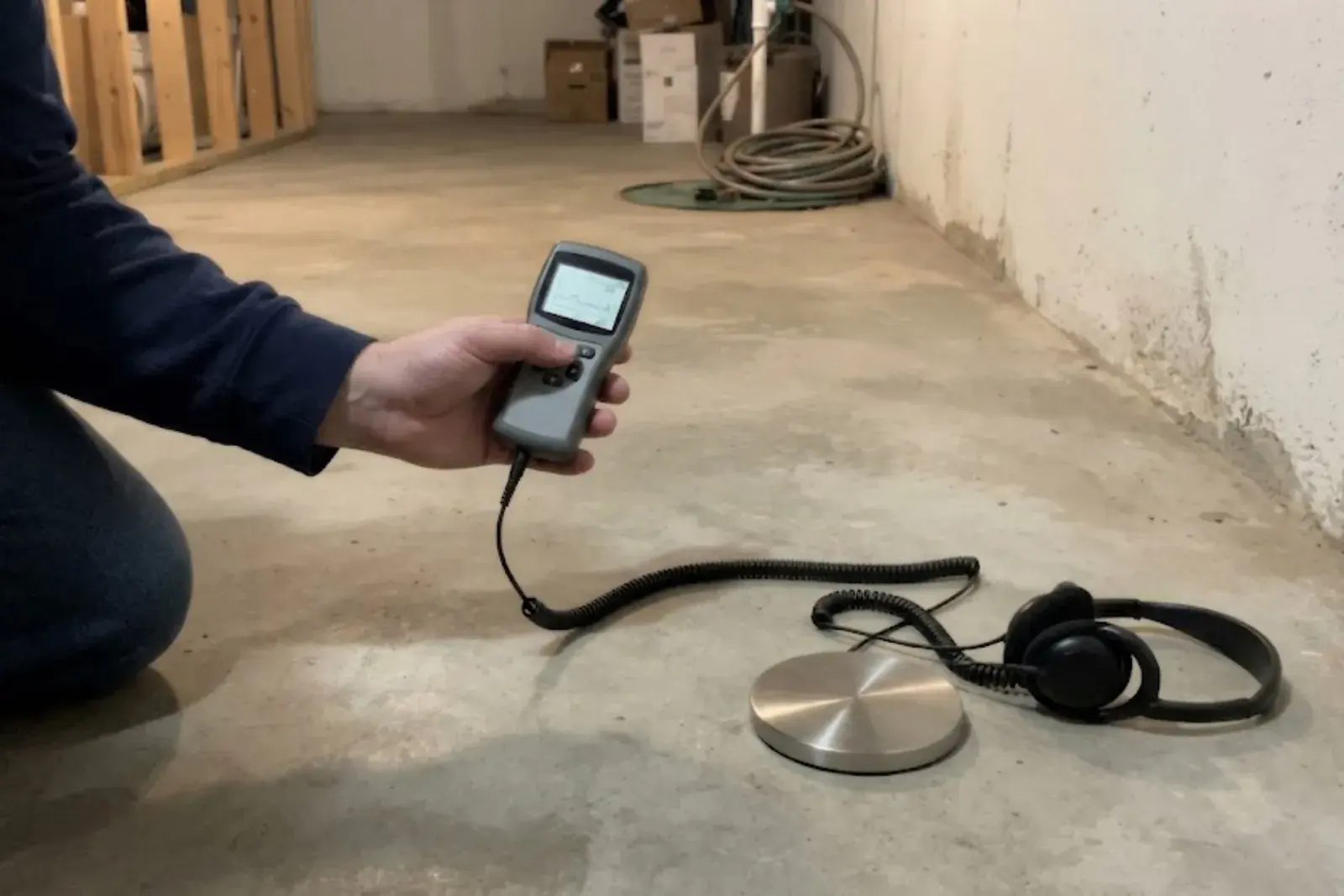
Then an acoustic listening device is used on the floor. A leak under pressure makes a distinct sound that travels through concrete, and the loudest point is marked. A thermal camera helps on hot lines because the warm path shows on the floor surface, and a pipe locator traces where the line actually runs under the slab.
Only after two methods agree do we discuss opening the floor. A marked, confirmed spot means a small opening, not a trench across the room.
Three ways to fix a slab leak, compared
The right choice depends on pipe age, how many leaks there are, and how much of the floor you are willing to open.
| Option | How it works | Best when | Trade-off |
|---|---|---|---|
| Spot repair through the slab. | Cut a small opening, repair the pipe, patch the concrete. | One leak, sound pipe elsewhere. | More leaks may follow on aging lines. |
| Reroute through walls or attic. | Abandon the slab line, run new pipe overhead. | Repeated leaks, or the line is hard to reach. | Needs wall or ceiling patching. |
| Repipe the house. | Replace the supply lines throughout, see repiping. | Failing pipe, several leaks over time. | Largest job, longest disruption. |
A single spot repair is often the right answer for a lone break. If a second leak appears within a short time, the pipe is usually telling you it is wearing out, and a reroute or repipe may cost less over time than repeated digging.
What drives the cost of a slab leak repair
Price depends on where the leak is, how deep and how thick the concrete is, whether the floor has tile, hardwood or carpet that must be removed and put back, and which repair option you choose. Rerouting and repiping cost more up front than a spot repair, but they address more of the system.
Insurance is worth a call. Many homeowner policies cover sudden water damage but not slow leaks or the failed pipe itself, so read your policy and ask your insurer. Ask whether tear-out and access costs are covered, and keep our leak report and photos.
Call for a clear price before work starts, and we will explain the options in plain terms. If a burst line is flooding the house, see burst pipe repair.
Lafayette lots, soft water and why age matters
EBMUD's Lafayette treatment plant water is very soft, at 16 mg/L hardness with a pH of about 9.0. That means mineral scale is usually low, so a failing slab pipe is more often tied to age, movement or a bad joint than to buildup. Test your tap and read the EBMUD water quality report if you want the numbers: EBMUD water quality report.
We dispatch from Lafayette around the clock, and neighbors in Moraga can call the same 24/7 line when a leak will not wait for office hours.
Slab leak questions, answered plainly
Yes. Our emergency line is staffed 24/7, including nights and weekends. Close the main valve, keep people off wet floors and call, and we will dispatch a licensed plumber.
Check the foundation edge outside and the garage floor. A slab shows flat concrete at ground level and no crawlspace vents or hatch. Many houses in this area mix foundation types, so confirm instead of assuming.
Yes. We isolate the lines, pressure-test them, and listen with acoustic equipment. A thermal camera and pipe locator help on hot lines. Only then do we cut a small opening at the marked spot.
Leak location, floor covering, concrete depth, the number of leaks and which fix you choose. Spot repair, reroute and repipe each cost differently. Call and we will give you a clear price before work starts.
Many homeowner policies cover sudden water damage but not slow leaks or the failed pipe itself. Your policy and insurer have the final word, so call them early and keep photos and the detection report.
Treat it as one if water is rising through the floor or the meter runs steadily. Close the main valve and call. A slow leak can wait for a scheduled visit, though same-day appointments are available when schedules allow.
Still unsure what you are dealing with? Call the 24/7 line and describe it to a dispatcher.
Call (855) 575-2890