
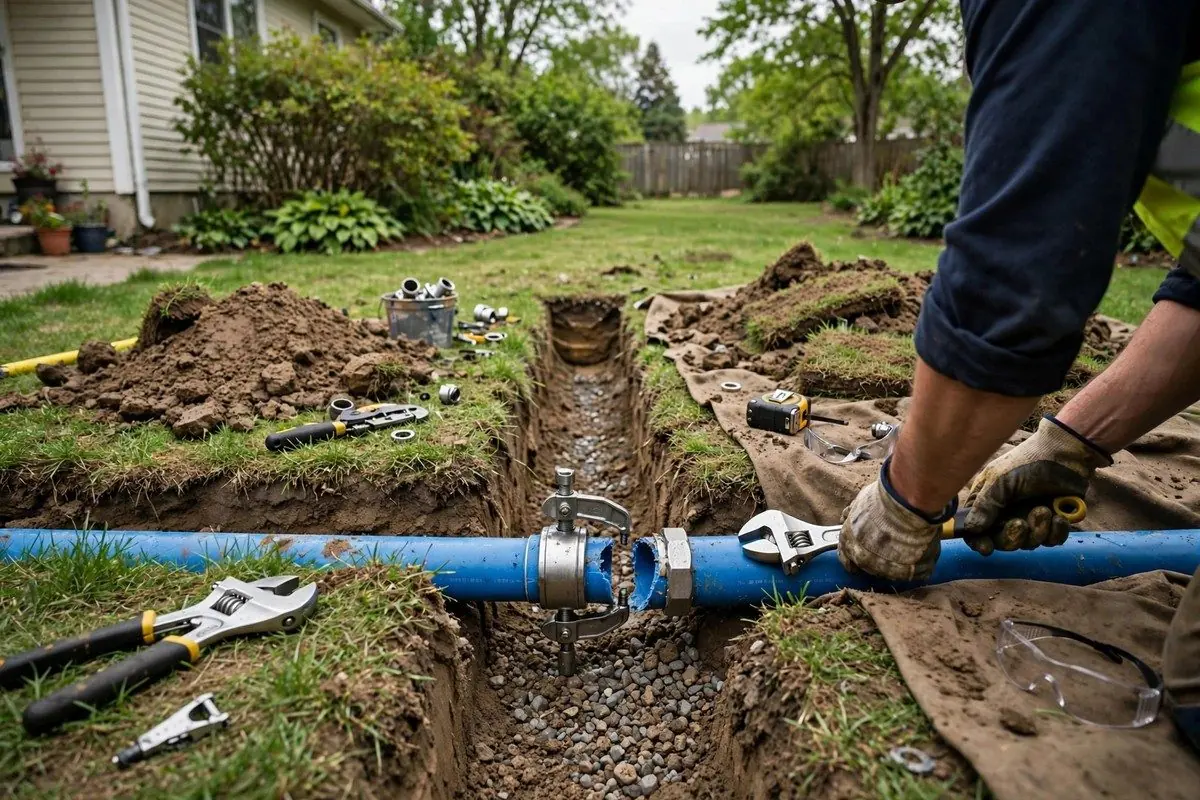
If your yard is turning soggy, the meter will not stop, or the water pressure suddenly dropped, the underground line from the meter to your house may be broken. Our 24/7 emergency line sends licensed plumbers for water line repair in Lafayette, CA, and while you wait you can close the houseline valve and keep kids and pets off the wet ground.
The water service line is the pipe that carries water from the EBMUD meter to your home. On the customer side of the meter, it belongs to you, and so does the repair bill. That makes it important to confirm exactly where the leak is before anyone digs.
This page covers the signs, a quick test to prove the line is leaking, the pressure problems that look similar, and how trenchless and open-trench replacement compare. A new line from the meter to the house is built to the California Plumbing Code, which is based on the Uniform Plumbing Code (UPC), and the property owner owns everything on the house side of the meter.
Whose pipe is it? The EBMUD meter is the dividing line
EBMUD is responsible for leaks on the street side of the meter, including the meter and its threads. Customers are responsible for leaks and repairs on the customer side, which includes the line running to the house. If water leaks on EBMUD's side, call EBMUD Emergency Dispatch at 1-866-403-2683 and press 1.
The meter is usually in a concrete box near the curb with the EBMUD logo on the lid. If you cannot tell which side the wet spot is on, do not guess. Water leaking from the meter or its threads is EBMUD's to fix. Water coming from the pipe between the box and the house is yours. EBMUD explains the split here: EBMUD guide for leaks and high bills.
Proving the line is leaking: a quick test
Run this before you call. It takes about an hour and tells us whether to bring line locating gear.
- Turn off all water inside and outside, including sprinklers, the dishwasher and the ice maker.
- Open the meter box and look at the leak indicator, often a small triangle or dial. If it moves, there is likely a leak.
- If it is still, mark the dial position with a toothpick, pin or photo, wait 30 minutes without using water, and check again.
- Shut off the houseline valve, mark the dial, and wait 30 minutes. If the dial moved, the leak is likely in the pipe between the meter and the house. If it did not move, the leak is likely inside the home.
A moving dial with the houseline valve closed means a service line leak. Call us, and also see our leak detection page for how the exact spot is pinpointed.
Signs the buried line is failing
Wet, sunken or unusually green ground
A soggy strip between the curb and the house, even in a dry week, often marks a leaking line.
Meter turning with water off
The most reliable sign. The test above tells you which side of the house to blame.
Pressure drop
The line may be leaking, but other causes exist. The next section sorts them out.
Brown or discolored water
Aging steel or iron pipe can shed rust. Water that runs clear after a minute may point to the line.
Sound of running water outside
A faint hiss near the meter or along the lawn at night can be the leak itself.
Bill jump
A steady loss adds up quickly even when the yard looks normal.
Low water pressure: line leak, regulator, valve or fixtures?
Low pressure across the whole house often means a supply problem, not a faucet problem. A leaking service line loses water before it reaches you. A failing pressure regulator can restrict flow or cause swings. A partly closed valve, or one with a worn gate, chokes the line.
If only one fixture is weak, the cause is usually local: a clogged aerator, a bad cartridge or a restricted supply stop. Run a few taps and see if pressure drops everywhere or only in one place.
A good plumber will check the meter, the regulator and the main valve before recommending a line replacement. Pressure alone does not prove a broken pipe.
Trenchless or open trench: honest trade-offs
Both methods work. Which one fits depends on what is above the pipe and how the pipe is built.
| Factor | Trenchless (pipe bursting or lining) | Open trench |
|---|---|---|
| Lawn and landscaping. | Small pits at each end, far less disturbance. | A continuous trench, then restoration. |
| Driveways and walkways. | Often can go under without cutting. | May need cutting and repair. |
| Fit | Needs a clean path and suitable pipe, not every line qualifies. | Works almost anywhere the soil allows digging. |
| Seeing the pipe. | Camera in the line, but less visual access. | Full view of the old pipe and joints. |
| Pipe replacement | New pipe pulled through the old path. | New pipe laid in a fresh trench. |
| Common drawback | May cost more per foot, and a bad path can limit it. | More digging, more cleanup. |
In rocky or tight spots, trench work may be the only choice. In a finished yard with mature landscaping, trenchless is often worth asking about. We tell you which one your line allows.
Before anyone digs: what to do first, 811 and permits
Call 811 (USA North 811 in Northern California) before any digging. They mark buried utility lines so a shovel or machine does not hit gas, electric or other pipe.
Permit rules vary, so ask the Lafayette building department about your job. Work in the street or public right of way needs a city encroachment permit as well, so ask the city before planning a connection point near the curb.
- Shut the houseline valve to stop flow while you wait.
- Keep children, pets and cars away from soft or sinking ground.
- If you smell gas near the work area, leave and call 911, then PG&E at 1-800-743-5000.
What drives the cost of a water line repair
Price depends on the line's length and depth, what sits above it (lawn, concrete, landscaping), whether a spot repair is enough or the whole line needs replacing, the pipe material, and permits and restoration. A short fix at a joint is very different from a full replacement.
Many homeowner policies cover sudden water damage but not slow leaks or the failed pipe itself, so read your policy and ask your insurer. Call for a clear price before work starts, and ask what restoration is included.
Lafayette note: soft water and nearby towns
EBMUD's Lafayette plant delivers very soft water, with hardness of 16 mg/L and a pH of about 9.0. Mineral scale seldom builds up inside pipes, so low pressure is less often a scale problem here and more often a leak, regulator or valve. Check the numbers in the EBMUD water quality report.
We dispatch from Lafayette 24/7 and also cover Orinda, where hillside lots can make the route from the meter to the house long and steep. If the line has failed repeatedly, ask about repiping and about burst pipe repair when water is actively flooding.
Water service line questions
Yes. The emergency line runs 24/7, including nights and weekends. Close the houseline valve, keep people away from soft ground and call.
EBMUD is responsible for leaks on the street side of the meter, including the meter and its threads. The customer side is the owner's responsibility. If the leak is on EBMUD's side, call EBMUD Emergency Dispatch at 1-866-403-2683 and press 1.
It depends on length, depth, soil and method. Trenchless work is often shorter on the surface, while open trench takes longer for digging and restoration. We explain the schedule when we see the site.
Permit rules vary, so ask the Lafayette building department. Work in the street or public right of way needs a city encroachment permit as well. Also call 811 before any digging.
Line length and depth, surface material above it, repair or replacement, pipe type, and permits. We give a clear price before work starts, so call and ask.
Maybe, but not always. A leaking line, a worn regulator, a partly closed valve or clogged fixtures can all lower pressure. Check the meter, test a few taps, and call so we can sort out which it is.
Still unsure what you are dealing with? Call the 24/7 line and describe it to a dispatcher.
Call (855) 575-2890