
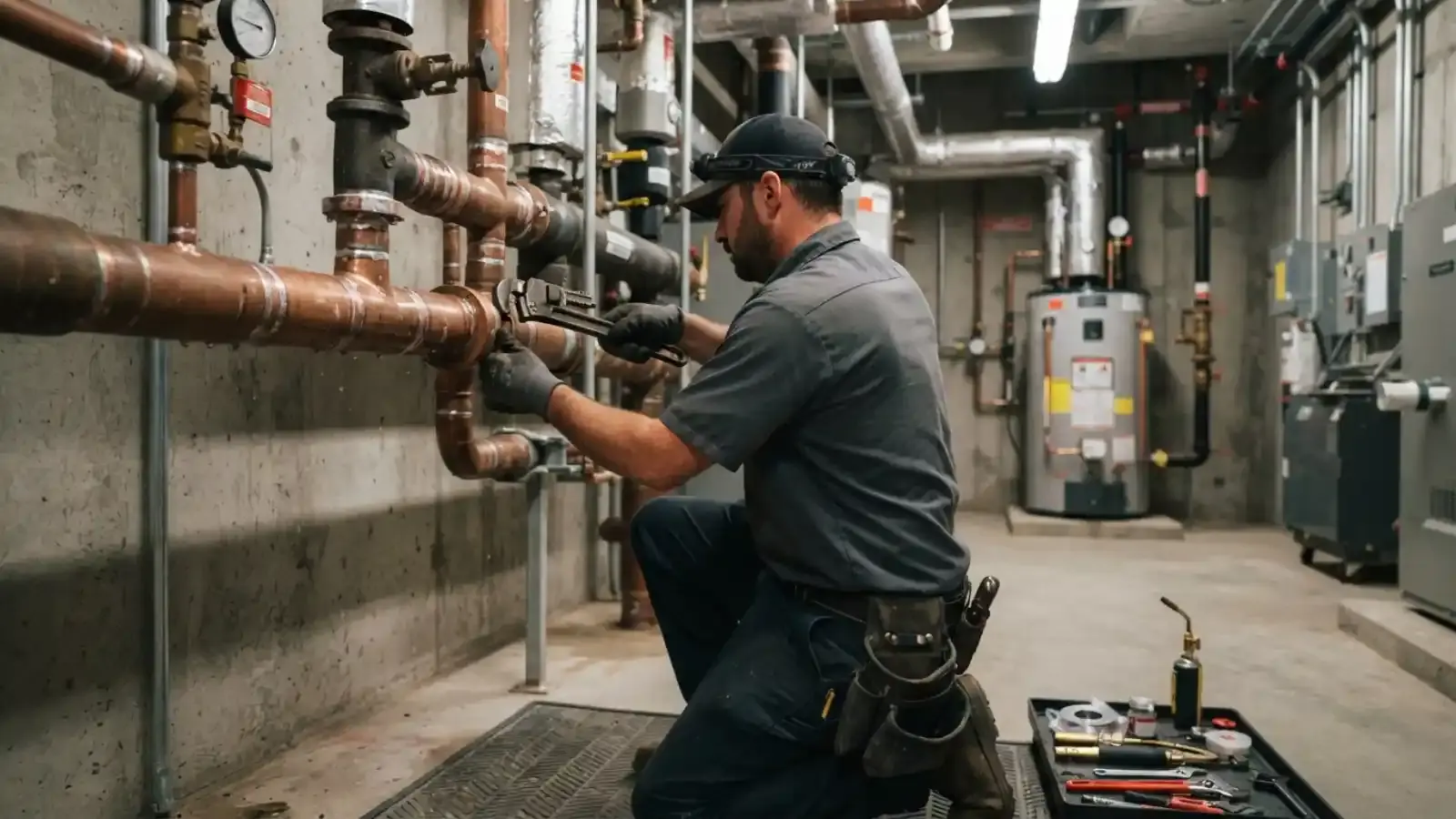
If your business is taking on water or a drain is overflowing, call our 24/7 emergency line now. While you wait, find the main shutoff, stop using sinks and toilets, switch off power to wet equipment only if you can reach the panel dry, and move people and stock away from the wet area.
Commercial plumbing in Lafayette, CA covers restaurants, offices, medical suites, salons and retail strips, and the problems rarely look like a house call. Floor drains back up, grease lines clog, lift pumps fail, and one tenant's leak lands in someone else's ceiling.
We send licensed plumbers who work after hours, on weekends and through holidays, because a commercial failure rarely waits for Monday. Bigger scopes get a site visit first, so the price you hear matches the building you actually have. Commercial work has its own backflow and fixture requirements, and licensed plumbers follow the California Plumbing Code, which is based on the Uniform Plumbing Code (UPC) for both.
Water on the floor after closing: the first ten minutes
A calm, ordered response limits damage to your space and to the tenants around you. These steps work for most small and mid-size commercial buildings.
- Find the main shutoff for the building or suite and close it. In multi-tenant buildings, the valve may be in a utility room, a back corridor or a riser closet, so ask the property manager now if you do not know.
- Turn off water heaters and booster pumps that feed the affected area if the switches are dry and within easy reach.
- Stay out of standing water near panels, outlets, walk-in coolers and kitchen equipment. Call your electrician or the utility if water is touching live electrical gear.
- Stop flushing and running sinks if a floor drain or sewer line is overflowing, because every gallon you add lands on the floor.
- Photograph the damage, move inventory and records up and away, and call us with the address, the floor and what you see.
If you smell gas anywhere in the building, leave, call 911, then call PG&E. Do not call a plumber first.
Restaurants, offices and retail strips: what actually goes wrong
Mt. Diablo Boulevard and other commercial corridors mix restaurants, salons, offices and small shops, and each type fails in its own way. Kitchens fight grease and food solids, offices fight old restroom fixtures and slow leaks, and retail strips share drain lines that one tenant can clog for everyone.
A shared building drain is the classic trap. When a downstream tenant's floor drain overflows, the cause is often a blockage upstream or in the common line, so the fix starts with finding where the stoppage actually sits. We use a push camera and a hydro jet to clear and confirm the line instead of guessing.
Floor drain overflows and lift pump failures
These two failures cause the most after-hours calls in commercial space.
Floor drain overflow
A floor drain backs up when the branch or main line is blocked. We clear it with a cable or jet, then camera the line to see why it clogged.
Lift pump or sump trouble
Basement restrooms and below-grade kitchens often pump waste upward. A stuck float, burned motor or clogged impeller sends waste back to the floor.
Repeat overflow
If the same drain overflows every few weeks, the line likely has a belly, roots or a collapsed section. Cleaning alone only buys time.
Pump alarm sounding
A high-level light or alarm means the pit is filling faster than it empties. Call before it overflows.
Commercial leak detection without tearing up the suite
A running meter with nothing in use means water is escaping somewhere. In commercial buildings the leak may be above a ceiling, inside a wall chase or under a slab, and opening everything to look is slow and expensive for the tenant.
We pinpoint hidden leaks with an acoustic listening device, pressure testing and, where it helps, a thermal check, then open only the spot that needs it. Our leak detection work also separates supply leaks from drain leaks, which decides who is responsible and what repair comes next.
On a metered account, EBMUD is responsible for the street side of the meter and the customer for everything past it. EBMUD describes the meter test in its guide for leaks and high bills.
Grease traps and storm drains
Two systems that get ignored until they fail:
| System | What fails | What we do |
|---|---|---|
| Grease trap or interceptor. | Full trap, odor, slow kitchen drains. | Pump out, clean baffles, inspect the lines. |
| Kitchen waste line. | Grease buildup downstream of the trap. | Jet the line and camera it. |
| Storm drain and area drain. | Leaves, silt and debris during winter rain. | Clear with a jet and confirm flow. |
| Roof and parking drains. | Standing water after storms. | Clear the line and check connections. |
Lafayette has dry summers and wet winters, so a storm drain that sat untouched since spring is the one that overflows in the first big storm. Ask us to clear it in the fall, not during the downpour.
Backflow testing and your water supplier
Many commercial properties have backflow devices on the water line, fire line or irrigation, and annual testing is commonly required by the water supplier. Rules differ by device and use, so ask EBMUD or the building department about your device and what paperwork they want.
We test and repair backflow assemblies, replace failed parts, and install new devices when a change in use calls for one. A device that fails its test is a repair job, and it is better handled before the notice deadline than after.
Property managers and landlords: calls, work orders and access
Multi-tenant buildings add coordination. These items keep an emergency from turning into a dispute.
- Tell us who authorizes work: the owner, the property manager or the tenant. We need that before we start anything beyond stopping the water.
- Share building shutoff locations and any riser maps ahead of time so tenants are not hunting for valves at midnight.
- Arrange after-hours access with keys or a lockbox code, plus a contact at the site if the suite is locked.
- Ask us for a written work order or invoice that names the unit, the cause and the repair, which helps with tenant disputes and insurance.
- Keep tenant calls routed through one person so we are not taking conflicting instructions from three suites at once.
What commercial plumbing costs and what changes the price
Price depends on what is failing, how deep the problem sits, and when you need us. An after-hours stoppage, a pump replacement and a camera-guided repair on a shared drain line are different jobs with different parts and labor.
Access matters too: ceiling height, whether the work is under a slab, tenant coordination and how much of the building must be shut off. Insurance can help, since many commercial policies cover sudden water damage but not gradual leaks or the failed pipe itself, so read your policy and ask your insurer.
We stay honest about limits. Small repairs get a clear price on the phone, while larger scopes such as a main replacement or a new fixture build-out need a site visit first. Call for a clear price before work starts.
Serving Walnut Creek and the Lamorinda corridor
Our dispatch is based on Mt. Diablo Blvd in Lafayette, and we also serve commercial buildings in Walnut Creek, where larger multi-tenant and mixed-use properties are common. Drive time varies with traffic on Highway 24, so tell the dispatcher how urgent the situation is and what is happening on site.
Commercial sewer laterals work the same way as residential ones: the property owner owns the lateral to the district main. Central San permits all lateral work beyond routine cleaning, and its home guide explains the basics.
Commercial plumbing questions from owners and managers
Yes. Our emergency line runs 24/7, including nights, weekends and holidays. Call, describe what is happening, and we will tell you what to shut off while a licensed plumber is dispatched.
The cause, the access, the hour and the size of the scope. Stoppages, pump work and hidden leak repairs are priced differently, and larger projects need a site visit first. We give a clear price before work starts.
Either the property manager or the tenant can call, but we need to know who authorizes the repair. We can stop the water first, then confirm responsibility before further work.
It depends on kitchen volume and trap size. A common rule is to clean before it is completely full, and many local agencies set a schedule, so ask the city or the sanitary district what applies to your kitchen.
Annual testing is commonly required by the water supplier for certain devices. Ask EBMUD or the building department about your device, and we can test it and report the result.
Often yes. Acoustic listening, pressure tests and a camera narrow the leak to a small spot, so we open only that section.
We handle service calls, repairs and smaller build-outs. Larger scopes get a site visit first so the plan, the parts and the price are clear.
Still unsure what you are dealing with? Call the 24/7 line and describe it to a dispatcher.
Call (855) 575-2890