
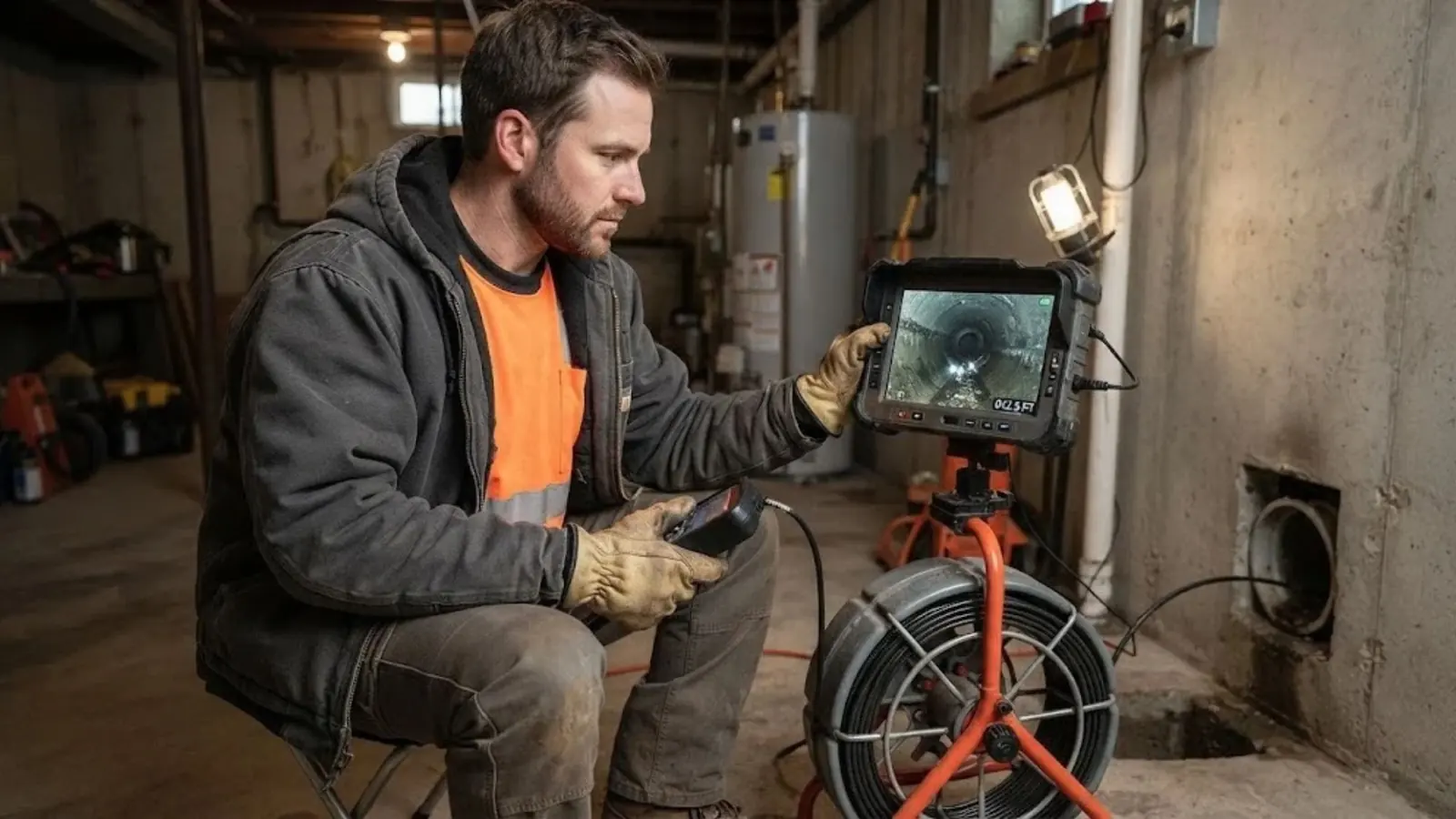
A sewer inspection answers a simple question: what is wrong with the pipe you cannot see? Our licensed plumbers push a waterproof camera through your sewer line in Lafayette, CA, record the run and mark where any problem sits. We can schedule it ahead of time, and if a backup has already happened our 24/7 line is open.
Most homeowners call for one after repeat slow drains, a backup that came back, or before spending money on landscaping or a home purchase. The inspection will not fix anything on its own. What it does is replace guessing with video, so the next decision about sewer line repair or cleaning rests on evidence.
Below is how the inspection works, what you will get at the end, and what a camera can and cannot tell you.
What the camera shows inside your sewer line
A push camera head with its own light travels down the pipe on a flexible rod. The video feed shows the pipe wall in real time.
Tree roots
Fine roots enter at joints and grow into dense masses that catch paper and waste. Root intrusion is the leading cause of sewer backups, according to Central San.
Bellies and sags
A low spot holds water and waste instead of letting it drain, so solids settle there and clogs repeat.
Offsets and separated joints
Where two pipe sections no longer line up, debris catches and soil can wash in.
Cracks and breaks
A cracked or collapsed section leaks wastewater into the soil and lets roots in.
Cast iron scale
Older cast iron pipe builds rough rust scale inside that narrows the pipe and snags waste.
Do you really have the equipment, and can you really see it?
Yes. We use a push camera with a self-leveling head, so the picture stays upright as the cable twists. The head carries bright lights and works in a pipe small enough for a typical house line. A video monitor and recorder capture everything, so you can watch it live or review it after.
We also use a locator. A small transmitter in the camera head sends a signal that a handheld receiver picks up above ground. That lets the plumber mark the exact spot of a root mass or crack on the lawn or driveway and read the depth. Without that, a video of a defect tells you what but not where.
Camera limits are real. Dirty pipe, standing water and heavy grease can blur the view. In those cases we often clean the line first, with an auger or a hydro jet (see sewer line cleaning), then inspect the clean pipe so the picture is clear.
What you get when the inspection is done
A good inspection leaves you with something to keep, instead of a verbal opinion.
- The recorded video of the full run, so you can watch it and share it with another contractor.
- Marked locations of every defect on the ground above, with an estimate of depth.
- Honest written findings: what we saw, how serious it looks and what we would do about it.
- A plain explanation of options, from monitoring and periodic cleaning to spot repair or replacement.
- A clear price before work starts for any repair that follows.
When to schedule one
Repeat slow drains are the best reason. If a line clears and slows again within weeks or months, something in the pipe is catching waste, and a camera shows what. Gurgling toilets, wet spots over the sewer path and a sewer smell outside are other cues.
Before major landscaping, an inspection can keep a new patio or tree from sitting on top of a failing line. As general advice, many buyers also choose to inspect the sewer line before closing on a home, since it is out of sight. We are not saying it is required, and you should ask your agent or inspector what fits your deal.
If a backup is happening right now, skip the schedule and call for emergency help. The inspection can follow once the line is flowing.
Cleanout access: the door to your sewer line
A cleanout is a capped pipe, usually outside near the house or at the property line, that gives direct access to the sewer lateral. With it, the camera goes straight into the line. Without one, we may have to pull a toilet, which takes longer and carries a small risk of damage.
Central San's guide tells owners to know where their cleanout is, and mentions a sewer popper, a cleanout cap relief device. Ask Central San what applies to your property. If you cannot find yours, tell us when you call and we will look for it.
Who owns the lateral: Central San facts
In the Central San service area, the property owner owns the whole sewer lateral from the house to the district main, including the part under the sidewalk or street. That matters because a defect under the street is still your repair to arrange.
All lateral work except routine cleaning needs a Central San permit, and digging in the street or public right of way needs a city encroachment permit as well. Central San's permit counter is at (925) 229-7371, and the main line is (925) 228-9500. More is in the Central San home guide.
We do not claim a camera inspection is required for any sale or permit. Ask Central San and the city building department what applies to your project.
What a sewer inspection cannot tell you
A camera is a strong tool, but it has blind spots. Here is how to read the results.
| Question | What the inspection can say | What it cannot say |
|---|---|---|
| Is there a clog? | Where it sits and what it looks like. | That it will never come back. |
| Are there roots? | Where they enter and how dense they are. | How fast they will regrow. |
| Is the pipe cracked? | Visible cracks, breaks and offsets. | Tiny leaks that leave no visible sign. |
| How long will the pipe last? | Its present condition. | An exact remaining lifespan. |
| Does it meet a lender or buyer's needs? | What it records on video. | Whether anyone will accept it. |
A small crack can be hard to see through a dirty lens, and some defects only show when the line is flowing. If a finding looks borderline, we say so rather than oversell it.
Sewer inspection pricing: what moves the number
Price depends on the line's length, how easy the cleanout is to reach, whether the line must be cleaned first, whether a locator is needed to mark defects, and the time on site. A short, accessible run is simpler than a long line with a hidden cleanout.
Insurance rarely covers a camera inspection, though some policies help with sudden damage found afterward. Read your policy and ask your insurer. Call for a clear price before work starts, and we will tell you up front what is included.
Serving Lafayette and nearby towns
Central San serves Lafayette, Moraga, Orinda, Pleasant Hill and Walnut Creek, so the same lateral ownership rules apply across these towns. We dispatch from Lafayette and also inspect lines in Pleasant Hill, where many homes are rentals and owners often want video before deciding on repairs. Same-day appointments are available when schedules allow.
Sewer camera inspection questions
It depends on the line's length, how easy the cleanout is to reach and whether cleaning is needed first. Most of the time goes to the camera run and marking any defects.
Someone should be there to give access to the cleanout and to hear the findings. You can watch the live feed and ask questions as we go.
No. The head is designed for sewer pipe and moves on a flexible rod. If the pipe is badly broken or collapsed, the camera may stop at that spot, which is itself a finding.
Often, yes. If a clog blocks the view, we clean the line first, then record the clear pipe. That second run shows cracks, offsets and bellies that the clog was hiding.
Line length, cleanout access, whether cleaning is needed first, whether a locator is used and the time on site. We give a clear price before work starts.
As general advice, many buyers do, because sewer lines are out of sight and repairs can be large. No inspection is claimed to be required for a sale, so ask your agent what fits your purchase.
Still unsure what you are dealing with? Call the 24/7 line and describe it to a dispatcher.
Call (855) 575-2890