
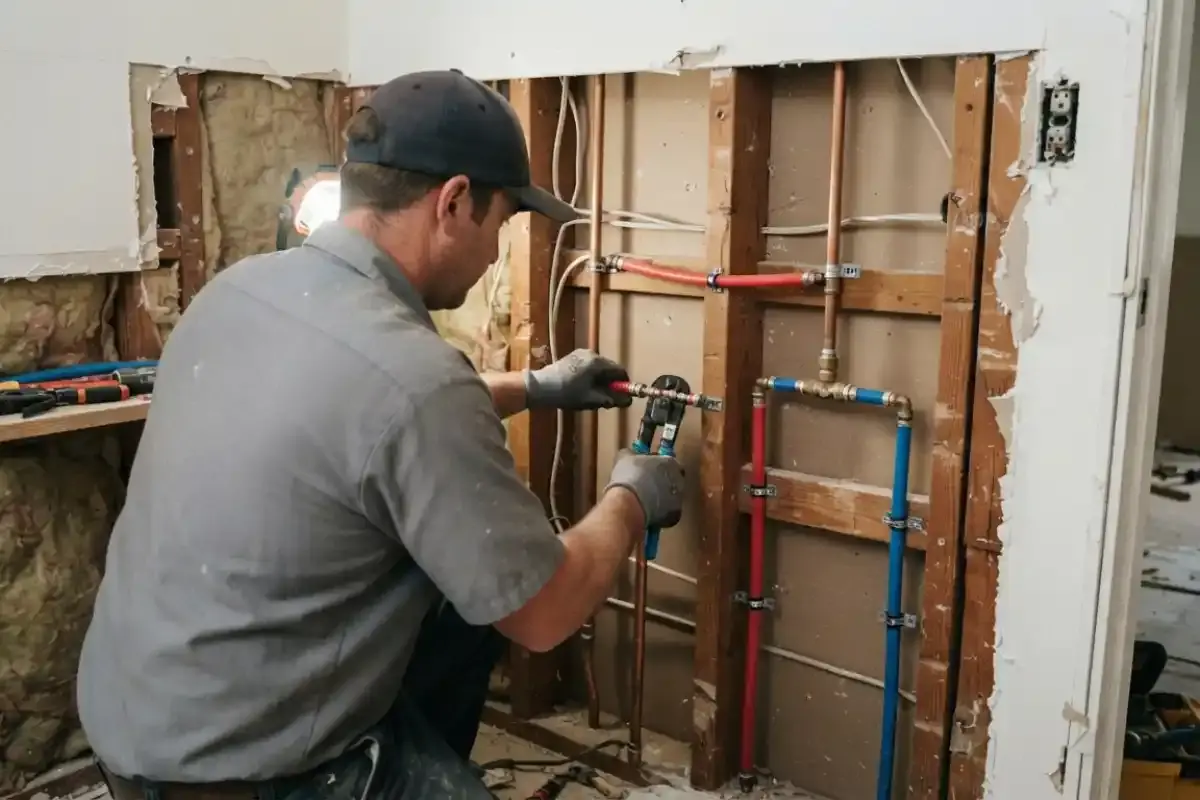
Repiping in Lafayette, CA usually starts the same way: a pinhole leak, a stained ceiling, brown water after a few days away, or a shower that dribbles. One repair holds for a while, then a second pipe fails a few feet away, and the pattern tells you the whole system is tired.
A repipe replaces the water supply lines throughout the house, or a defined part of it, with new copper or PEX. It does not touch the drains. We are licensed plumbers, and we walk the house with you before quoting so the plan fits the pipes you actually have.
Planned work is scheduled with you, though an active leak can be handled any hour on our 24/7 line while the larger repipe is set up. New supply lines are sized, supported and joined to the California Plumbing Code, which is based on the Uniform Plumbing Code (UPC), which is the standard every inspector works from.
Which old pipes fail, and how they show it
Three materials account for most repipe decisions in older houses.
Galvanized steel
Zinc-coated steel rusts from the inside out. Expect falling pressure, rust-brown water and narrowing pipes.
Polybutylene
A gray or blue plastic pipe used in some homes for a period, known for failing at fittings. Most plumbers recommend replacing it before it leaks.
Old copper
Copper lasts a long time, but thin-walled or aggressively eroded runs develop pinholes. A few pinholes in separate places is a warning.
Mixed repairs
Patches of different metals joined over the years can corrode at the joints and leak again.
Repipe or keep repairing: a decision table
Use this as a starting point, then let a plumber look at your actual pipe.
| What you see | Likely direction | Why |
|---|---|---|
| One leak, pipes otherwise sound. | Repair | A single failure on healthy pipe rarely calls for a full replacement. |
| Repeated pinholes in different spots. | Repipe | Pipe walls are thinning throughout, not at one point. |
| Rusty water and low pressure. | Repipe (galvanized) | Internal buildup does not clear by itself. |
| Polybutylene found in walls. | Plan a repipe. | Fittings can fail without warning. |
| Leak only in one room. | Partial repipe | Replace the affected branch and test the rest. |
| Leak under the slab. | Reroute or repair. | See the slab section below. |
A plumber can often check pipe condition from an access point, a cut-out or a fitting that is already open. If a plumber quotes a repipe without looking at the pipe, ask what they based it on.
Copper or PEX: choosing the new pipe
Copper is rigid, long-lived and familiar. It costs more in material, takes longer to install and needs soldered joints, but it tolerates heat and sunlight and has a long track record.
PEX is flexible plastic tubing. It bends around corners, which means fewer joints and less wall opening, and it handles freeze-thaw swings well. It cannot sit in direct sunlight and should be protected from some chemicals, but most homeowners find it faster and less disruptive to install.
Ask which brand and fitting system the plumber uses, how the pipe is supported, and what the warranty covers from the manufacturer. Local code decides what is allowed, and the plumber should follow the California Plumbing Code (Title 24, Part 5, based on the Uniform Plumbing Code).
Whole-house or partial repipe
A whole-house repipe replaces every supply line from where the line enters the house to every fixture. It is the better fit when the pipe is the same age and material throughout and has already failed in several places.
A partial repipe replaces one section, such as the kitchen and bath branch, an upstairs run or a single leaking trunk line. It saves money and disruption, though the remaining old pipe can still fail later, so ask the plumber what condition it is in.
A good plumber maps the pipes first and will tell you which approach fits instead of pushing the larger job.
What living through a repipe looks like
Most homeowners ask about the disruption. Here is the usual order of events.
- Walk-through and plan: we find the main, the shutoffs and where walls or ceilings must be opened.
- Water is shut off during the work. Plan for windows when you cannot use sinks or toilets, and we will tell you roughly when they start and end.
- Small access cuts are made in drywall, and new lines are run, tied in and pressure tested.
- Water comes back on, we flush the lines and check every fixture for leaks.
- Wall openings are patched. Final paint and texture are usually a separate trade, so ask what is included and what is not.
Pressure, color and taste: signs the pipes are the problem
Not every symptom means a repipe. Check these first.
- Low pressure at every fixture while the street supply is fine can point to buildup inside galvanized pipe, though a partly closed main valve or a failed pressure regulator is also possible.
- Brown or orange water that clears after running often means rusting steel, though a recent water heater service can cause a brief cloudy flush.
- A drop in pressure when two fixtures run together suggests narrowed pipes.
- Wet spots, stains or unexplained water bills suggest a leak, and leak detection can find it before you decide on a repipe.
- Metallic taste or green staining on fixtures can come from corroding pipes, so have a plumber look.
After a slab leak: repair, reroute or repipe
When a supply line under a concrete floor fails, you can spot-repair it, bypass it with a new line run through the attic or walls, or repipe the house. The slab leak repair decision depends on how many leaks the pipe has already had and where the remaining pipe runs.
Rerouting avoids breaking the slab again and again. Ask for the options in writing, with the trade-offs for each, before you pick one.
Local note: soft water, chloramine and your pipes
EBMUD supplies Lafayette and its report puts Lafayette plant water at about 9.0 pH with very soft hardness. Scale buildup inside pipes is therefore usually low, so galvanized pipe here is more often rusting from age than clogged by minerals.
Read the EBMUD water quality report if you want the specific numbers, and ask a plumber to check older copper and fittings for pinhole corrosion either way.
Permits, inspections and what a repipe costs
Permit rules for repiping vary, so ask the Lafayette building department what applies to your project. Lafayette contracts with Contra Costa County for plan check and inspection, and a licensed plumber should handle the permit paperwork and be present for the inspection. You can verify any plumber at the CSLB license check.
Price factors: house size, number of fixtures, one or two stories, pipe material, how many walls open, attic or crawlspace access and whether a partial or whole-house repipe fits. Drywall patching and paint add to the total if you want them done.
Many homeowner policies cover sudden water damage but not slow leaks or the failed pipe itself, so read your policy and ask your insurer. Call us for a clear price before work starts, and for a water line problem outside the house, see water line repair.
Repiping help around the area
We serve Lafayette and neighboring towns, including Pleasant Hill, where much of the housing is postwar and many homeowners ask about older plumbing. Ask for a walk-through, and call about same-day appointments when available.
Repiping questions homeowners ask
Repeated pinhole leaks, rusty water, falling pressure and known galvanized or polybutylene pipe are the main signs. A plumber should look at the pipe before recommending a full repipe.
It depends on house size and access. Many homes are done in a few days, and water is usually off for part of each day rather than the whole time. We will lay out the plan before starting.
Most people stay home, but you will lose water for stretches and have some dust. Plan bathroom and cooking access around the shutoff windows.
House size, fixture count, pipe material, wall and ceiling access, partial or whole-house scope and patching. Call for a clear price before work starts.
Both are accepted by the California Plumbing Code when installed correctly. Copper lasts long and tolerates heat and sun, while PEX is faster and needs fewer wall openings.
Usually not the pipe itself. Some policies cover sudden water damage, so read your policy and ask your insurer.
Yes. A partial repipe works when the problem is limited to one branch, though we will tell you if the remaining pipe looks tired.
Still unsure what you are dealing with? Call the 24/7 line and describe it to a dispatcher.
Call (855) 575-2890