
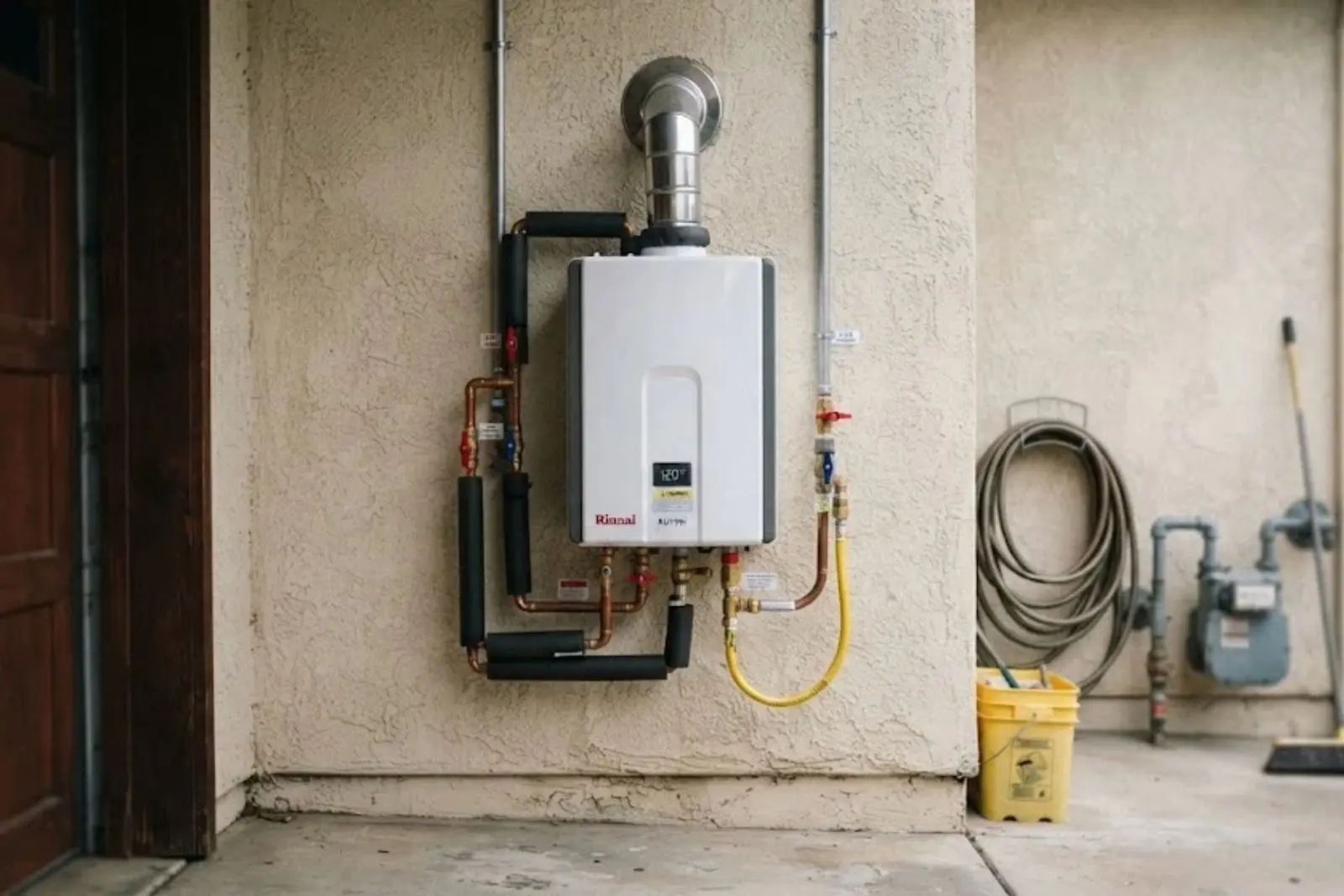
A tankless water heater gives you hot water only when a tap is open, with no storage tank to rust or flood. We install, repair and service these units in Lafayette, CA, and the work splits into three parts: sizing the unit, keeping it clean, and fixing it when an error code appears.
Most trouble traces back to gas supply, flow, or maintenance that was skipped. This page walks through each, so you know what a good setup looks like and when a call makes sense. Our 24/7 line is open if a unit fails and leaves you without hot water. Gas, venting and condensate drain details follow the manufacturer's instructions and the California Plumbing Code, which is based on the Uniform Plumbing Code (UPC).
How an on-demand heater makes hot water
When you open a hot tap, a flow sensor tells the unit to fire. A gas model lights a burner under a heat exchanger, and an electric model energizes heating elements, and either way the water is heated as it passes through.
That is why flow rate matters. Each unit has a maximum number of gallons per minute it can raise by a given temperature, and running a shower, dishwasher and laundry at once can exceed it. The result is water that goes lukewarm, not cold.
Gas or electric, and what each needs
Gas tankless
Delivers the highest flow. Needs a properly sized gas line, a dedicated vent, and a condensate drain on condensing models.
Electric tankless
Compact and ventless. Draws a large load, so the panel and wire must be able to carry it.
Gas line sizing
A tankless burner uses much more gas at once than a tank. An undersized line starves it and causes shutdowns.
Flow sizing
Add up the fixtures you run together, then match the unit's rated flow at your coldest incoming water.
Flushing and descaling: the part people skip
Mineral scale coats the heat exchanger and narrows its passages. The unit then runs hotter, wastes energy, and eventually throws an error or fails. A flush pushes a descaling solution, usually a mild acid such as vinegar or a manufacturer-approved product, through the unit with a small pump and two hoses.
How often depends on your water and on the manufacturer. Many makers call for a yearly flush, and some warranties require proof of it. Read your unit's manual and follow its schedule.
EBMUD Lafayette water is very soft, at about 16 mg/L hardness, so scale usually builds slowly here. That is a reason the interval may feel long, not a reason to skip it, because the manufacturer's schedule and the inlet screen still need attention. The EBMUD water quality report has the current figures.
Error codes and when to call
Codes differ by brand, so your manual is the final word. These are the common families.
| Code family | Typical meaning | Try first | Call when |
|---|---|---|---|
| Ignition failure | Burner did not light. | Check gas valve is open. | Code repeats after reset. |
| Flame loss | Burner lit then went out. | Check for a blocked vent. | Smell of gas or soot. |
| Overheat | Heat exchanger too hot. | Clean the inlet screen. | Returns after cleaning. |
| Scale or flow. | Passage restricted | Flush the unit. | Flush does not clear it. |
| Venting | Exhaust blocked | Look for debris at the termination. | Any sign of fumes indoors. |
| Sensor | Faulty temperature or flow reading. | Power cycle once. | Code stays |
If you smell gas, leave the building, call 911, then call PG&E at 1-800-743-5000. Do not try to reset the unit.
Keep it running on cold nights
Winters here are mild, so frozen tankless units are rare. Still, exposed vent terminations and water lines on an outside wall can get cold on a clear night, and some units have built-in freeze protection that only works while powered. Insulate exposed pipes and leave the unit plugged in.
Upgrade or keep the tank
| Question | Keep the tank | Go tankless |
|---|---|---|
| Floor space | You have room. | You need the wall space. |
| Hot water demand. | Predictable | Large or irregular. |
| Gas line and vent. | Already suitable | Upgrade is practical. |
| Current tank condition. | Sound and young. | Old, leaking or failing. |
| Upfront work | Lower | Higher, with venting or electrical changes. |
If you are leaning toward a conversion, water heater installation covers the site checks we run first.
Repairing a tankless unit
Repair visits follow a consistent order.
- We read the error code, check the history, and ask what changed before it failed.
- Gas pressure, venting, and the inlet filter are checked, since they cause many faults.
- The unit is flushed if scale is suspected, and sensors, igniters or the flow valve are tested.
- If a part has failed, we replace it, test fire the unit, and confirm temperature at several taps.
- If the heat exchanger is cracked or the unit is near the end of life, we explain the cost of a new one against water heater repair for a tank.
What shapes the price of tankless work
Installs depend on the model, gas line upsizing, venting, electrical upgrades and how far the unit sits from existing pipes. Service pricing depends on the part that failed and whether the unit has ever been flushed. A first flush on a neglected unit takes longer.
Many homeowner policies cover sudden water damage but not routine wear, so read your policy and ask your insurer. Call us, and we will give a clear price before work starts. For other nearby customers, we also serve Pleasant Hill.
Tankless questions homeowners ask
Follow the manufacturer's schedule, which is often yearly. Water hardness affects how fast scale forms, and Lafayette's EBMUD water is very soft, so buildup tends to be slow. The inlet screen and any warranty terms still make the schedule worth keeping.
Usually the demand is more than the unit can heat, or scale or a clogged inlet screen has cut its output. A plumber can check the flow and gas supply to tell which.
Sometimes, but the line often needs to be larger. We measure the run and the appliance load before recommending it.
It depends on the model, gas and vent work, electrical needs, and the condition of the unit. Call, and we will quote a clear price before work starts.
It is uncommon, given mild winters. Exposed lines and vents can still get cold, so insulate them and keep the unit powered.
It depends on space, household size, and gas line suitability. Our table above sets out the main trade-offs, and we can compare options on site.
Still unsure what you are dealing with? Call the 24/7 line and describe it to a dispatcher.
Call (855) 575-2890