
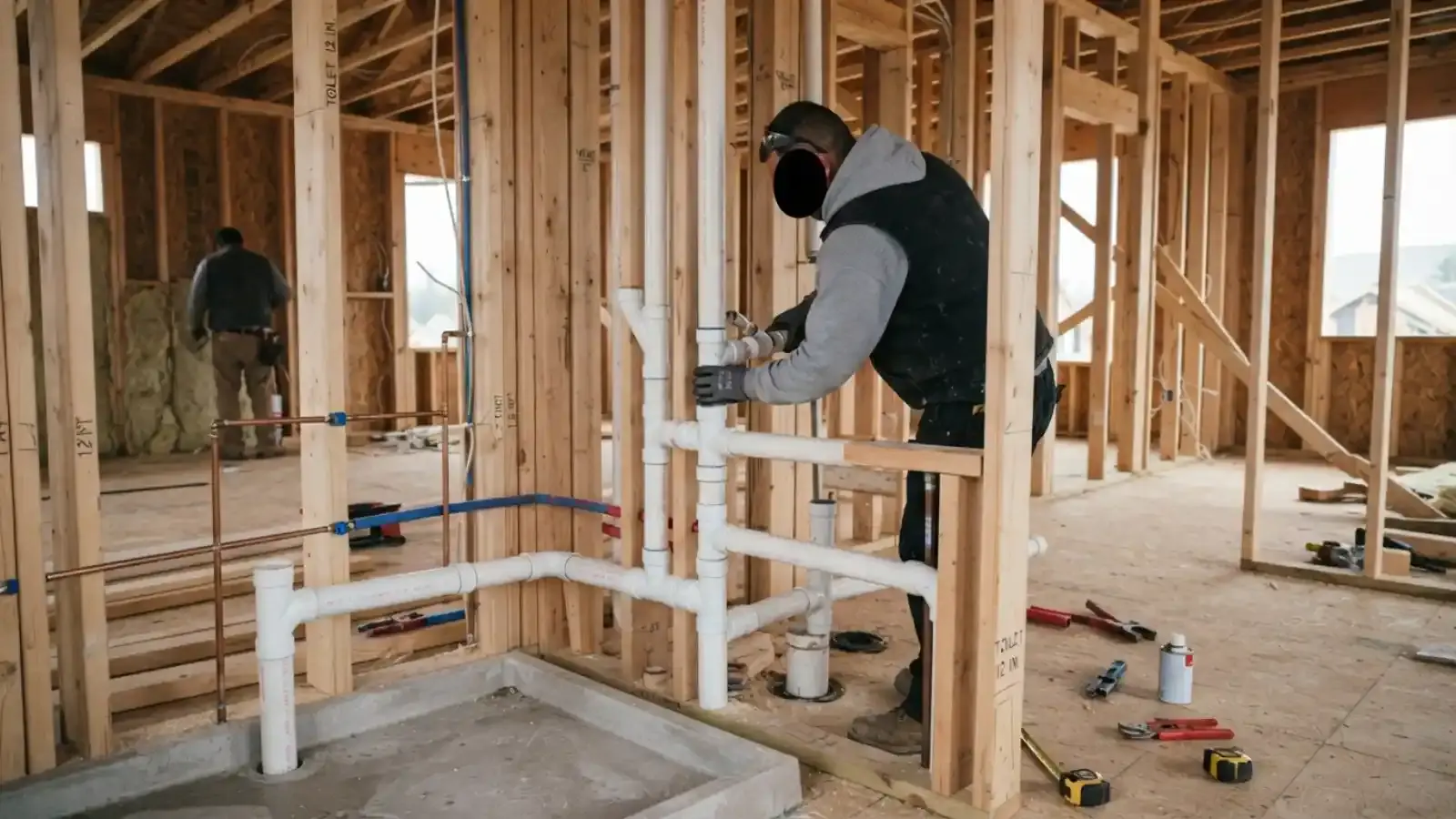
Plumbing installation in Lafayette, CA covers everything from swapping a toilet to roughing in a whole new bathroom. If you are remodeling a kitchen, finishing a laundry room or adding an ADU or addition, the plumbing decisions come early, before drywall and cabinets lock the layout in place.
We are licensed plumbers who install fixtures, supply and drain lines, appliance connections and gas piping to the California Plumbing Code. This is planned work, scheduled around your project, though our 24/7 line is open if something fails along the way.
Tell us what you are building and what you have chosen so far. We will say what the walls, floor and existing lines allow before you buy fixtures that do not fit.
Remodel rough-in: where plumbing gets decided
Rough-in is the stage when pipes are set in open walls and floors before they are closed up. It fixes where every drain, vent and supply line ends, so a shower valve placed two inches off or a sink drain in the wrong stud bay is expensive to correct later.
For a kitchen, that means sink, dishwasher and ice maker lines. For a bath, it means a shower valve, tub spout, toilet flange and lavatory. For a laundry, it means a washer box and a standpipe with a trap. Bring your fixture selections, or the spec sheets, before rough-in starts.
An ADU or addition adds a separate question: whether existing lines can handle the extra load, or whether new supply and drain connections are needed. We can look at that during a site visit.
What we install
The usual list for homeowners and small remodels.
Toilets and sinks
New toilets, lavatories, kitchen sinks and bar sinks with proper traps, stops and supply lines. If a toilet already rocks or leaks, see toilet repair.
Shower and tub valves
Pressure-balance and thermostatic valves, trim kits and diverters set at the right depth for your wall.
Appliance lines
Dishwasher supply and drain, ice maker lines, washer boxes and water heater connections.
Hose bibs
Frost-resistant or standard outdoor spigots with a vacuum breaker, set to drain and not trap water.
Water heaters
Tank, tankless, hybrid and heat pump models. Our water heater installation page covers sizing and venting in detail.
Sump pumps
Pump, check valve and discharge line, with a backup option for wet seasons.
Gas line work: safety comes before any plumber call
If you smell gas, leave the building immediately, call 911, then call PG&E at 1-800-743-5000. Do not use matches, light switches or flashlights inside, and do not call a plumber before you have called 911 and PG&E. Read the PG&E gas leak safety page for the full steps.
We do not promise a response time for gas leaks. That job belongs to the fire department and PG&E first.
Planned gas piping: ranges, dryers, fire pits and outdoor kitchens
Installing or extending a gas line is licensed work that usually requires a permit and an inspection. Permit rules vary, so ask the Lafayette building department before work starts, and ask your plumber to pull the permit if one is needed.
The pipe is sized for the total load of the appliances it feeds, run with the proper material and protected where it passes through walls and framing. After installation, the line is pressure tested before it is connected, then leak-checked at each fitting. PG&E handles the meter and restoring service if gas was shut off at the meter.
Call 811 before any digging near buried lines.
Your installation project from first call to final inspection
Most installs follow this path.
- Site look: we check the existing supply, drains, vents, shutoffs and the room where the fixture will go.
- Fixture and scope list: you choose fixtures, we confirm they fit and list what else is required, such as new valves, venting or a wall opening.
- Permit check: we tell you whether a permit applies and who pulls it.
- Install and test: supply lines are pressure tested, drains are filled and checked, and fixtures are set and tested before closing walls.
- Inspection and handoff: if an inspection is required, it happens before walls are closed, and we show you the shutoffs.
Pick the install type that fits your project
| Project | What changes | Typical sequence |
|---|---|---|
| Swap a fixture. | Same location, same lines. | Shut off, remove, install, test. |
| Move a fixture. | New supply and drain routing. | Open wall or floor, rough-in, inspect, close. |
| New bath or kitchen. | Full rough-in, venting, valves. | Plan, permit, rough-in, inspect, finish. |
| Laundry add | Supply box, drain, vent. | Rough-in then appliance connection. |
| ADU or addition. | New lines or tie-in to existing. | Plan with building department, rough-in, inspect. |
Code, permits and inspection: ask before you build
California plumbers follow the California Plumbing Code, Part 5 of Title 24, which is based on the Uniform Plumbing Code (UPC). City of Lafayette lists water heater repair and replacement at single-family homes as exempt from a building permit, but for fixtures, relocations and gas lines, permit rules vary, so ask the Lafayette building department.
Lafayette contracts with the Contra Costa County Building Inspection Department for plan check and inspection. Verify any plumber you hire at the CSLB license check, and look for a C-36 plumbing classification.
Installation cost: what moves the number
The biggest drivers are replacing a fixture in place versus moving it, how much wall or floor must open, and the fixture itself. Premium valves, wall-hung toilets and custom sinks cost more than standard ones, and a water heater swap that needs a new vent or gas line adds work.
Access also matters: slab floors, tight crawlspaces and finished walls take more time than open framing. Permits, inspections and patching are separate lines on some projects.
Insurance rarely pays for planned upgrades. Call for a clear price before work starts, and if old supply pipe is the real issue, look at repiping first.
Serving the Lamorinda hills
We install in Lafayette and nearby towns including Orinda, where oak-covered hills can mean longer pipe runs and tricky access for slopes and crawlspaces. We bring the right pipe, fittings and test gear, and we check the shutoff and drain locations before we start.
For a quote, call and describe the project. Same-day appointments are available when schedules allow, and we will tell you if the job needs a site visit.
Before you order fixtures: common install questions
Permit rules vary. City of Lafayette lists water heater repair and replacement at single-family homes as exempt from a building permit, but for other work, ask the Lafayette building department.
Often yes. Share the model number first so we can check that it fits the supply, drain and mounting, and that all parts are included.
Fixture choice, whether work is in place or relocated, wall and floor access, permits and any needed valves, vents or lines. Call for a clear price before work starts.
Leave the building, call 911, then call PG&E at 1-800-743-5000. Call a plumber only after that.
Yes. They need space, airflow and a condensate drain, and sometimes an electrical upgrade, so we check the location first.
Pump size depends on the pit, the inflow and the discharge distance. Ask for a pit inspection and a check valve, and test it before the wet season.
Still unsure what you are dealing with? Call the 24/7 line and describe it to a dispatcher.
Call (855) 575-2890