
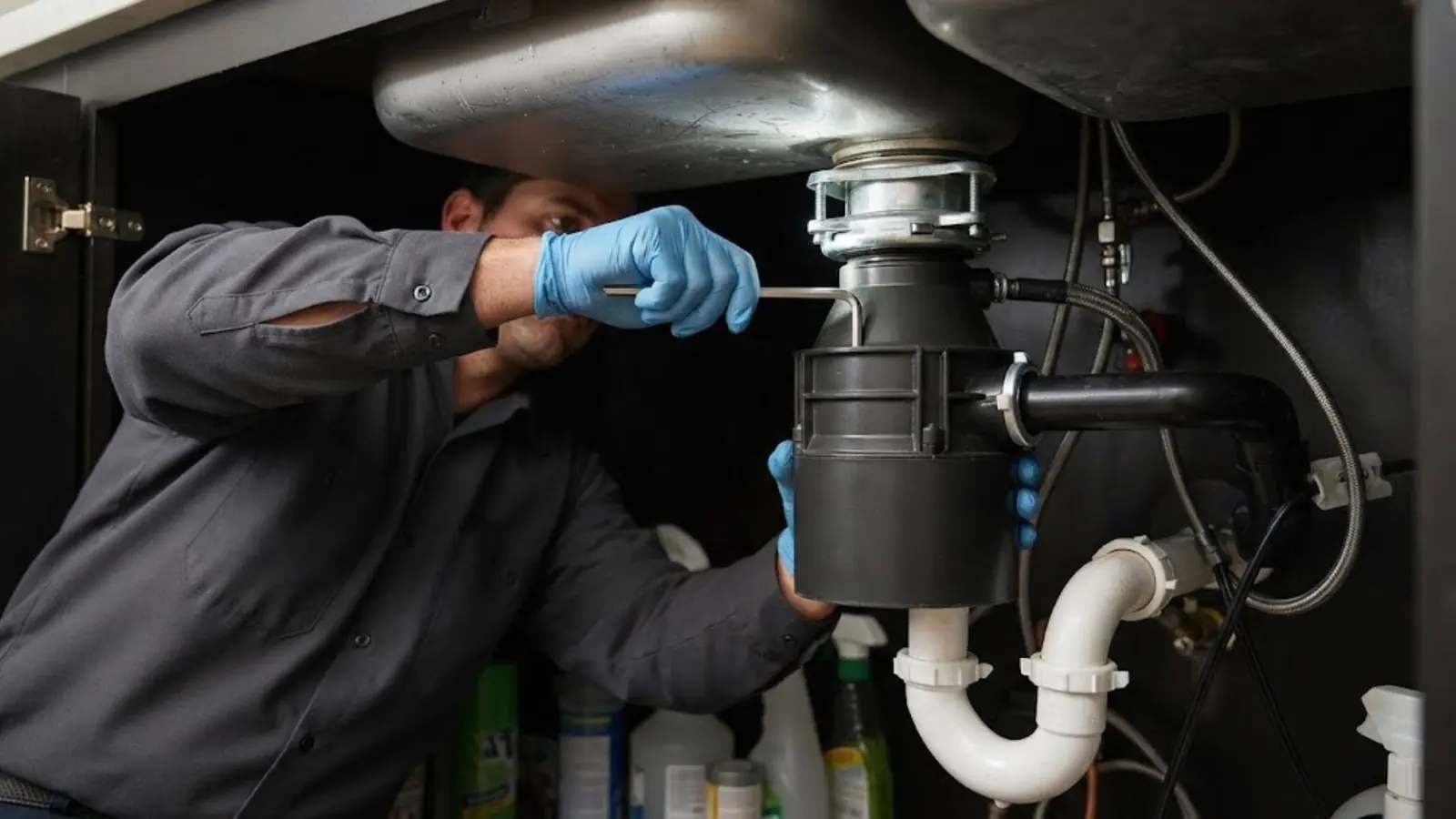
If your disposal hums but will not spin, or water is dripping from the unit, switch it off at the wall and do not put your hand in the drain. Our emergency line runs 24/7 for garbage disposal problems in Lafayette, and you can call while the power is off.
A disposal can fail on its own, or it can be the visible symptom of a clog further down the kitchen drain. Telling those apart saves you from replacing a unit that was never the problem.
Read on for fast checks, leak diagnosis, replacement choices and what to keep out of the hopper.
Humming, jammed or silent: what to check before you call
Cut power first. Turn the switch off and, if you can, unplug the unit or flip its breaker.
- Never reach into the hopper. Use tongs or pliers to pull out a spoon, bone or bottle cap you can see.
- Insert a 1/4 inch hex key into the socket in the center of the bottom and work it back and forth to free the flywheel.
- Press the red reset button on the underside once the unit has cooled.
- Restore power and run cold water. If the motor still hums with no spin, the unit is likely seized.
- If it is silent and the reset does not click, the problem may be the outlet, the switch or the motor.
If any of these steps feel unsafe, stop and call.
Where a leaking disposal drips from
The location of the drip tells you the repair.
| Leak location | Likely cause | Usual fix |
|---|---|---|
| Top, under the sink flange. | Worn gasket or loose mounting ring. | Reseat the flange with fresh plumber's putty and gasket. |
| Side, at the dishwasher hose. | Loose clamp or cracked hose. | Replace clamp or hose. |
| Side, at the drain outlet. | Loose bolts or bad gasket. | Tighten or replace the gasket. |
| Bottom of the unit. | Cracked housing or failed seal. | Replace the disposal. |
A leak from the bottom of the body almost never repairs. Seal failures inside the housing mean a new unit.
Backing up into the other sink basin
When you run the disposal and water rises in the second basin, the blockage is past the disposal. The trap or the kitchen branch line is clogged, usually with grease and food paste that coated the pipe over time. The disposal pushes more waste into the same narrowing line.
Dishwashers drain through the disposal or the same trap arm. If the dishwasher leaves standing water, or sink water backs into the machine, expect the clog to be in that shared drain. This is a job for drain cleaning, with an auger or hydro jet, and it often fixes the disposal complaint too.
Clearing the kitchen branch is quicker than most people expect, as long as the main line is clear.
Replacing a disposal: what to choose
Size, mounting and wiring all matter when we swap a unit.
Horsepower
A one-half horsepower unit suits light use. Three-quarter or one horsepower grinds tougher scraps and runs quieter.
Mounting and flange
Many sinks fit a standard three-bolt mount. We check that the flange and gasket match your sink and the drain arm height.
Electrical
Most units use a switched outlet under the sink or a hardwired box. We do not rewire beyond plumbing scope, and can point you to an electrician if the circuit needs work.
Dishwasher knockout
New disposals have a plug in the dishwasher port that must be punched out, or the dishwasher will not drain. We do that and reattach the hose.
A plumber's quick-fix list when the unit dies
If the unit has failed and you are waiting on us, these steps keep the kitchen usable.
- Turn off the disposal switch and the breaker if you suspect an electrical fault.
- Close both angle stops under the sink if water is dripping, or the main if they stick.
- Remove standing water with a cup or small bucket, and put a pan under the unit.
- Wash dishes in a tub and empty it outside until the drain is clear.
- Do not pour drain chemicals into a jammed disposal. They sit in the unit and splash onto whoever services it.
What belongs in the hopper, and what does not
Disposals handle soft food scraps and small amounts of cooked leftovers. Grease, fat and cooking oil are the worst offenders, because they cool and coat the drain wall. Coffee grounds pack into sludge. Potato peels, rice and pasta swell and turn into paste. Bones, fruit pits, corn husks and fibrous stalks wear out the blades or jam them.
Run cold water for 15 seconds before and after use, and feed scraps in slowly rather than all at once. If the unit smells, ice cubes and a citrus peel can help, though they do nothing for a drain that is already narrowed.
Why the kitchen drain is your responsibility in Lafayette
Lafayette's sewer service comes from Central San, and the property owner owns the lateral running from the house to the district main. Food waste and grease that leave your disposal travel into that lateral, and Central San names roots as the leading cause of backups. Grease only makes the narrowing worse.
Know where your cleanout is, and read the Central San home guide for details. We also serve neighbors in Orinda and can arrange same-day appointments when available.
Disposal repair or replacement: how cost shapes up
Price depends on whether the unit can be repaired or must be replaced, the horsepower you choose, mounting and wiring condition, the dishwasher connection, and whether a drain clog sits behind it. An after-hours call also changes the labor.
Water damage from a sudden leak may be covered by your homeowner policy, but a failed appliance usually is not. Read your policy and ask your insurer. For fixture work beyond the disposal, see faucet repair and plumbing installation. Call for a clear price before work starts.
Disposal problems we get asked about
Yes. Our line is staffed 24/7 including weekends. Switch the unit off, keep hands out of the hopper, and call.
Repair or replacement, horsepower, mounting hardware, electrical access and any downstream clog all matter. Call and we will give you a clear price before work starts.
Something is jamming the flywheel, or the motor is seized. Cut power, free the flywheel with a hex key, then press reset. If it still hums, it likely needs replacing.
The knockout plug inside the dishwasher port may still be in place. It has to be punched out for the dishwasher to drain through the disposal.
No. Hot water moves grease along, but it cools further down the pipe and coats the walls. Wipe pans with a paper towel and throw the grease in the trash.
It can contribute, because grease and food paste build up in the lateral. Roots are the main cause, but a partly blocked line fails sooner if you send scraps down it.
Still unsure what you are dealing with? Call the 24/7 line and describe it to a dispatcher.
Call (855) 575-2890