
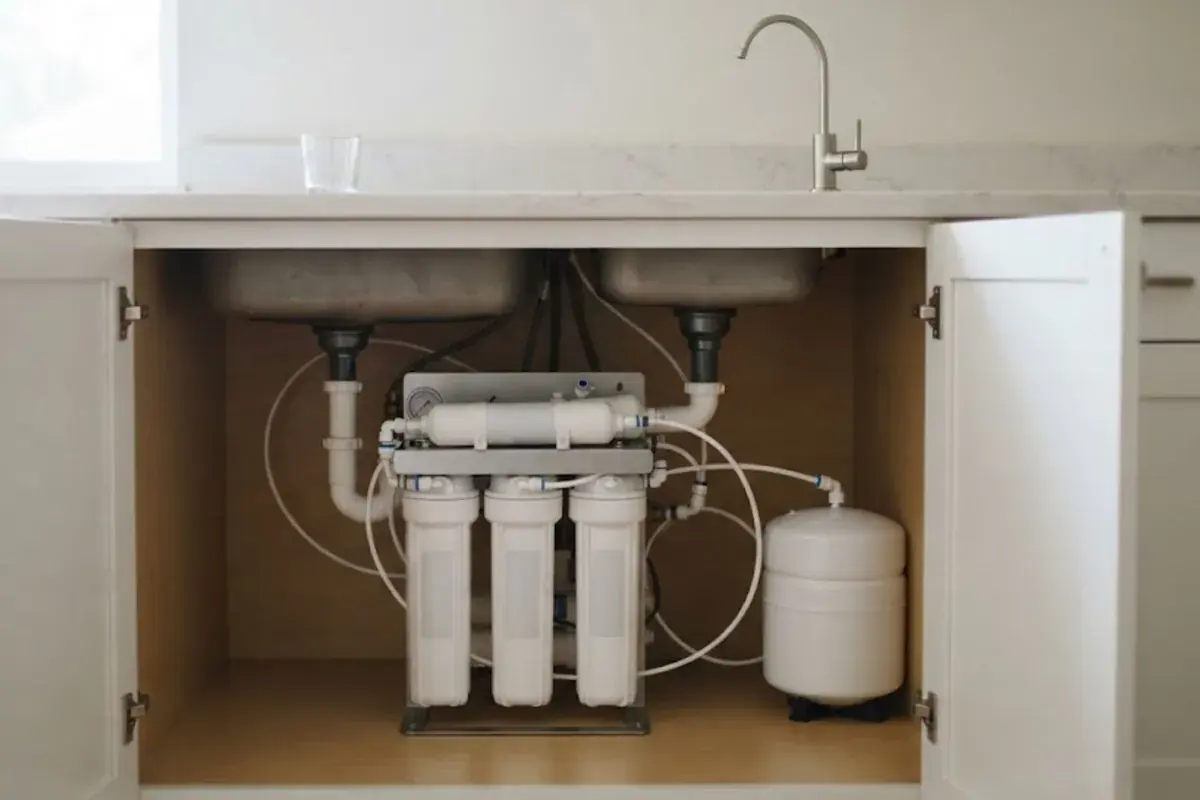
A reverse osmosis faucet that drips, leaks at the base or only trickles usually has one of four causes: a worn faucet cartridge, a loose fitting, an old filter, or low pressure in the storage tank. Most of these are findable in under an hour with a flashlight and a towel.
This guide covers reverse osmosis faucet repair for Lafayette homes. We walk through each symptom, show how filter and membrane timing affects flow, and mark the point where a licensed plumber is the better call.
Start by looking under the sink. The tank, the tubing, and the small shutoff valve on the feed line tell you most of what you need to know. Drain saddles and air gaps for RO systems follow the California Plumbing Code, which is based on the Uniform Plumbing Code (UPC) and the manufacturer's guidelines.
Start here: three checks before you touch the faucet
A leaking RO line can run quietly into a cabinet for days. Do these checks before you disassemble anything.
- Close the small feed valve on the cold supply line under the sink, then close the valve on top of the storage tank.
- Dry every fitting and the cabinet floor with a towel, then watch for the first bead of water to find the true source.
- If water has reached anything electrical, such as a disposal plug, keep the circuit off and keep people away until it is dry.
Why the RO faucet drips from the spout
An RO faucet is a small, separate tap, usually mounted in a spare hole on the sink or counter. It has a ceramic cartridge or a rubber seat that opens when you lift the handle. When that part wears or a grain of grit lodges in it, water seeps past and drips from the spout.
A slow drip after you close the handle is normal for a few seconds. The line is still under pressure from the tank, and it needs a moment to settle. If it drips steadily for minutes, the cartridge or seat is worn.
Many RO faucets use a replaceable cartridge. Look for the brand stamped on the base, then match the cartridge to the model. Guessing at parts is the most common reason a repair fails the first time.
Leak at the faucet base or under the counter
Water pooling around the base of the faucet comes from one of two places. Either the base gasket has hardened, or the connection under the counter has loosened, and water is wicking up the shank.
Reach under the sink and check the nut that holds the faucet in place. Snug it by hand, then a quarter turn with a wrench, but stop there. Cracked countertops and stripped plastic threads are expensive mistakes.
If the leak is where the tubing meets the faucet stem, the tubing end may be cut crooked or scored. Cutting a clean, square end and re-seating it fully often cures the leak.
Slow trickle or no flow: a symptom guide
Match what you see to the likely cause. Start with the cheapest and simplest check first.
| Symptom | Likely cause | What to try |
|---|---|---|
| Weak flow, fills glass slowly. | Clogged filter or low tank pressure. | Check filter dates, then test tank pressure. |
| Strong at first, then trickle. | Tank air charge too low. | Add air to the tank bladder. |
| No water at all. | Closed feed valve or kinked tubing. | Open valves, straighten the line. |
| Spurting or sputtering. | Air in the lines. | Run the faucet open for several minutes. |
| Tastes off, flows fine. | Spent carbon filter. | Replace prefilter and postfilter. |
| Constant drain noise. | Failed check valve or drain saddle. | Call a plumber. |
Several causes can stack. A new filter will not fix a tank with no air in it.
Low tank pressure: the quiet cause of slow flow
The storage tank holds treated water behind a rubber bladder. Air on the other side of the bladder pushes the water out when you open the faucet. If that air charge drops, the tank may be full of water yet deliver only a trickle.
To check, close the tank valve and open the RO faucet until it stops flowing. Then use a tire gauge on the air valve on the side of the tank. Most small RO tanks run at a low charge when empty, so confirm the number on the tank label or in the manual.
Add air with a bicycle pump if it reads low. If water comes out of the air valve when you press it, the bladder has failed and the tank needs replacing.
Filter and membrane replacement: how to decide
Most RO systems have two or three prefilters (sediment and carbon), the membrane, and a final carbon polishing filter. Prefilters protect the membrane. When they clog, flow drops and the membrane works harder than it should.
A practical rule: replace sediment and carbon prefilters on the schedule in your manual, and replace the membrane only when your treated water tastes worse or your tester shows the output has climbed. Changing the membrane to fix a slow trickle is often wasted money, because the real fault is upstream or in the tank.
A small TDS meter, sold at hardware stores, lets you compare tap water with RO output. If the gap has narrowed a lot, the membrane is the likely culprit.
Tubing, fittings and the drain saddle
Most RO leaks live at a push-in fitting or at the drain connection. Look for these before you buy parts:
- Tubing that is kinked, flattened, or pulled partly out of its quick-connect fitting.
- A collar on a push-in fitting that is not fully seated, which lets water seep past the O-ring.
- A drain saddle clamped onto the drain line that has loosened or cracked, which causes a gurgle or a drip below the P-trap.
- Plastic threaded fittings that were over-tightened and have hairline cracks.
- Old tubing that has gone stiff and brittle. Replace it rather than patching it.
Release a push-in fitting by pressing the collar in and pulling the tube out. Cut a fresh, square end before you push it back in.
Do it yourself or call a plumber
Cartridge swaps and filter changes are well within reach for most homeowners, and our faucet repair work covers the rest. Anything that touches the sink drain or the supply valve is a different story.
| Task | DIY | Call a plumber |
|---|---|---|
| Swap faucet cartridge. | Yes | If the faucet body is corroded. |
| Replace filters | Yes | Rarely |
| Recharge tank air. | Yes | If the bladder has failed. |
| Recut or replace tubing. | Yes | If many fittings leak. |
| Replace drain saddle. | Maybe | If the drain pipe is damaged. |
| Add or move the feed valve. | No | Yes |
| Water behind cabinet or wall. | No | Yes, right away. |
If a stop valve will not close or a fitting keeps weeping after you reseat it, call. A licensed plumber from our plumbing installation crew can usually replace a feed valve and re-run RO tubing in one visit. Ask for a clear price before work starts.
Cost factors, without the guesswork
What a repair costs depends on what is actually broken. A cartridge or a length of tubing is a small job. A failed storage tank, a corroded feed valve, or a wet cabinet base is a bigger one.
Other factors include how easy the under-sink space is to reach, whether the faucet hole is in granite or quartz, and whether parts are in stock. Many homeowner policies cover sudden water damage but not slow leaks or the failed part itself, so read your policy and ask your insurer.
When you call, describe the brand, the symptom and how long it has been going. That lets us give a clear price before work starts.
Lafayette note: very soft water and chloramine
EBMUD supplies Lafayette, and its treatment plant water here is very soft, at 16 mg/L of hardness (about 0.9 grains per gallon). Hard water scales RO membranes, so with water this soft the membrane scaling that shortens membrane life in many places is typically low. That means a slow trickle in Lafayette is more likely a clogged prefilter, a tank air problem, or a worn faucet part than a scaled membrane.
EBMUD also treats with chloramine, about 2.6 mg/L at the Lafayette plant. Carbon filters are what remove chloramine taste, so the carbon prefilter and postfilter are the parts to keep on schedule. A spent carbon stage can pass chloramine to the membrane and the glass.
We serve Orinda and Walnut Creek too, and EBMUD reports differ by plant. Check the Lafayette numbers yourself in the EBMUD water quality report, and keep in mind that an RO system here is about taste and preference, not about hardness.
RO faucet questions from Lafayette homeowners
A short drip is normal while the line settles. A steady drip means the faucet cartridge or seat is worn or has grit in it. Replace the cartridge with the exact model for your faucet, and check that the tubing is not kinked behind the spout.
Follow the interval in your system's manual for the prefilters and final carbon filter. The membrane lasts longer and is judged by taste and a TDS meter reading, not by the calendar alone.
Usually yes. Close the small feed valve on the line to the RO unit and the valve on the tank. If that valve will not close or the leak is on the cold supply itself, shut off the house main and call.
EBMUD's Lafayette water is very soft with chloramine, so membrane scaling is typically low while carbon filtration matters for taste. Test your tap and read the EBMUD report if you are unsure about what your system needs.
Yes. We handle under-sink leaks, feed valves, tubing and faucet replacement for homes in Lafayette and nearby towns. Call, describe the symptom, and we will give a clear price before work starts.
Still unsure what you are dealing with? Call the 24/7 line and describe it to a dispatcher.
Call (855) 575-2890