
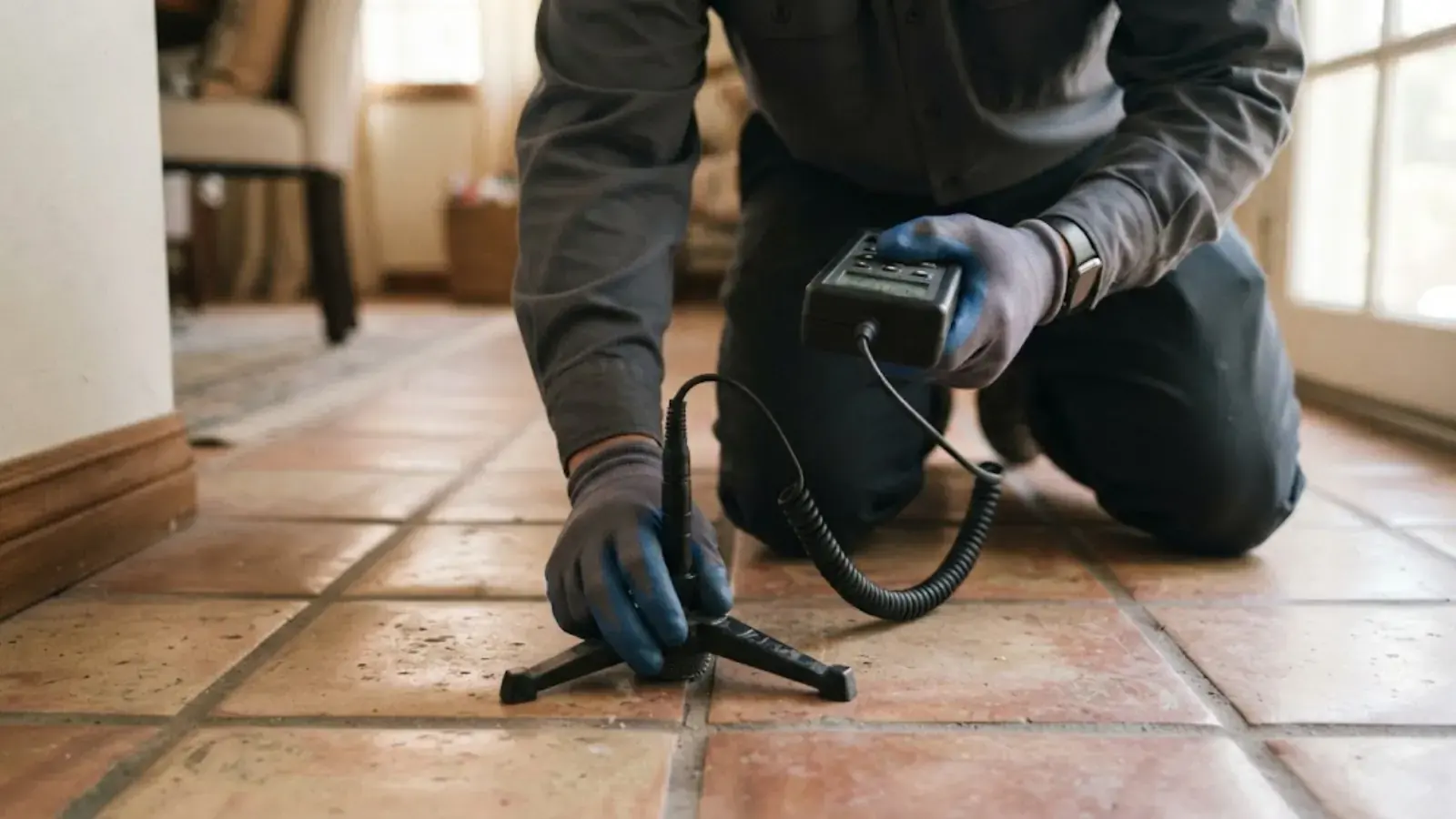
Water leak detection works by combining a few simple clues: sound, temperature, moisture, pressure and sight. No single tool finds every leak, so a good plumber picks the method that fits where the water is likely hiding.
If you suspect a leak in your Lafayette home, you can run one quick test yourself before anyone arrives. It tells you whether water is escaping at all, and roughly which side of the house it is on. The steps are in the local note below.
The sections that follow explain each professional method in plain terms, what it can and cannot find, and when it is worth calling for professional leak detection instead of guessing. Pressure testing follows standards set out in the California Plumbing Code, which is based on the Uniform Plumbing Code (UPC), which is why plumbers test a line to a defined pressure rather than guess.
Start with the meter: the check that costs nothing
Before paying anyone to listen at your walls, find out whether water is actually leaking. Your water meter already does that job. Shut off every tap, appliance and irrigation zone, then watch the meter's leak indicator.
If it keeps moving with everything off, water is going somewhere. That one result narrows the search more than any gadget can, and it tells a plumber whether to look in the yard, under the floor or inside a wall.
Acoustic listening: hearing water escape a pipe
A pressurized pipe with a hole in it makes a faint hiss or buzz. An acoustic listening device uses a sensitive ground microphone or a contact probe and headphones to pick up that sound through concrete, soil or drywall.
The technician moves along the suspected route and listens for the point where the noise is loudest. That spot is usually directly above the leak, which lets us open a small section instead of a large one.
This method works best on pressurized supply lines and struggles when the pipe is plastic, because plastic carries sound poorly. Traffic, running appliances and heavy rain can also drown out a small leak, so quiet conditions help.
Thermal imaging: seeing temperature differences
An infrared camera does not see water. It sees surface temperature. A hot water line leaking under a floor warms the material above it, and a cold water leak can cool a wall or ceiling.
Thermal imaging is fast for scanning a large area and it is great at showing where to point other tools. It is also easy to fool. A sunny window, a vent or a recently run dishwasher can create patterns that look like leaks.
For that reason a thermal image is a lead, not proof. We treat a warm patch as a reason to confirm with a moisture reading or a pressure test before cutting anything.
Moisture meters: confirming that a surface is wet
A pin meter measures electrical resistance between two probes pushed into wood or drywall. A pinless meter reads through the surface with a flat sensor. Both tell you how wet the material is compared with a dry reference spot.
Moisture meters are the right tool once you already know roughly where to look. They show whether a stain on a ceiling is active or old, and they map how far water has spread inside a wall.
They cannot say where the water entered. A pipe leak, a roof leak and a condensation problem can all give the same wet reading, so the result needs context from the other methods.
Pressure testing: proving a section of pipe is tight
A pressure test isolates a section of pipe and watches whether it holds. It is the most direct way to prove a leak exists, and it separates the pipes that are fine from the ones that are not.
The basic sequence looks like this:
- The technician closes the valves that isolate one run of pipe, such as the line to a water heater or the line under a slab.
- A gauge is attached and the line is brought up to test pressure, or read at its normal working pressure.
- The gauge is watched for a set time. A steady needle means the section is tight.
- A falling needle means water is escaping somewhere in that section, so the search narrows to those pipes.
- Valves are then closed in smaller steps until the falling section is as short as possible.
Pressure testing does not tell you the exact spot. It tells you which pipes to focus on, and it pairs well with acoustic listening to finish the job.
Tracer gas: finding the leak that makes no noise
When a leak is too quiet to hear and the area is too large to guess, a technician can fill an isolated pipe with a harmless mix of hydrogen and nitrogen. Hydrogen is a very small molecule and it escapes through the smallest crack.
A sensitive sniffer then passes over the floor or ground and picks up where the gas rises. This works through slabs, tile and carpet, and it suits slow leaks that other tools cannot hear.
It takes more setup than listening, since the line must be drained and isolated first, so it is usually a second step after the simpler methods fail.
Line cameras: for drains and sewer lines
Supply leaks are not the only hidden water problem. A cracked or offset drain leaks wastewater into the soil. A push camera on a flexible rod travels through the pipe and shows cracks, root intrusion, bellies and broken joints on a screen.
A camera does not work on pressurized supply lines, because they are small and full of water. It earns its place for sewer inspection and for finding why a drain keeps backing up.
The camera also records the footage, which is useful when you need to see the damage before choosing between repair and replacement.
What each method finds and misses
Think of these as a toolbox. This table shows where each one is strong and where it falls short.
| Method | Best at finding | Weak spot |
|---|---|---|
| Meter check | Whether any leak exists. | Cannot give a location. |
| Acoustic listening | Pressurized pipe leaks under floors and yards. | Plastic pipe and noisy sites. |
| Thermal imaging | Hot water line leaks, wide scans. | False patterns from sun and vents. |
| Moisture meter | How wet a wall or floor is. | Cannot show the source. |
| Pressure test | Which pipe run is leaking. | No exact location. |
| Tracer gas | Very quiet slab or wall leaks. | Needs isolation and setup. |
| Line camera | Drain and sewer damage. | Does not suit supply pipes. |
Most real jobs use two or three of these together, starting with the cheapest and moving to the more involved ones.
What to do yourself before calling a plumber
None of these need tools, and they can save a service call or confirm that you need one.
- Look at the water meter with everything off and watch for movement.
- Check under sinks, behind toilets and around the water heater for damp cabinets or drips.
- Put a few drops of food coloring in each toilet tank and wait to see if color reaches the bowl without flushing.
- Walk the yard and look for unusually green, soft or soggy patches during dry weather.
- Note any new sound of running water when the house is quiet, and any warm spots on the floor.
- Write down your recent water bills if you have them, since a steady climb points to a slow leak.
If any check points to a leak, shut off the water at the main and call. For a leak you can see actively spraying, shut off the main first, then call. If a leak is near electrical outlets or a panel, stay away from the area.
What affects the cost of finding a leak
Cost depends on how hidden the leak is and how many methods it takes to confirm. A visible drip under a sink needs little detection. A quiet leak under a slab may need listening, a pressure test and tracer gas.
Access matters as well. Pipes behind finished walls, under tile or beneath landscaping take longer to trace and cost more to open and close afterward.
Detection is also separate from repair. Many homeowner policies cover sudden water damage but not slow leaks or the failed pipe itself, so read your policy and ask your insurer about detection costs. Call for a clear price before work starts so you know what is included.
We run detection calls for Lafayette homes and for neighbors in Moraga and Orinda, and the same methods apply on both sides of the hills.
Lafayette note: the EBMUD meter and houseline test
EBMUD supplies water to Lafayette, and its guide for leaks and high bills describes a simple test. Your meter is usually in a concrete box near the curb with the EBMUD logo on the lid. Turn off all water in and around the home and see whether the leak indicator (often a small triangle or dial) is moving.
If it moves, there is likely a leak, which means a plumber should start with a listening or pressure check rather than a full search.
If the indicator is still, try a pin test. Mark the dial position with a toothpick, a pin or a photo, wait 30 minutes without using any water, and check again. A moved dial points to a leak. A dial that did not move suggests the problem is intermittent, such as a toilet or irrigation valve, so check those next.
To tell which side of the house the leak is on, run the houseline test. Shut off the houseline valve, mark the dial, and wait 30 minutes. If the dial moved, the leak is probably in the pipe between the meter and the house, so call a plumber. If it did not move, the leak is likely inside the home, and a thermal or acoustic check can pick up from there.
Leak detection questions from Lafayette homeowners
Technicians use sound, temperature, moisture and pressure to find the spot before any cutting happens. Acoustic listening and thermal imaging point to the area, and a moisture reading or pressure test confirms it. Only the small section above the leak usually needs to be opened.
No single method wins every time. Acoustic listening is strong for pressurized lines, tracer gas handles quiet leaks, and pressure testing proves a leak exists. Accuracy comes from combining two or three methods and checking that they agree.
You can confirm that a leak exists and often tell which side of the house it is on, but not the exact spot. Use the meter test, then the houseline valve test, to narrow the search before a plumber gets involved.
Not directly. It shows temperature differences on the surface, which can suggest water behind it, especially with hot water lines. The result should be confirmed with a moisture meter or a pressure test before anyone cuts into drywall.
Find the meter box near the curb with the EBMUD logo on the lid, turn off all water in and around the home, and watch the leak indicator. If it moves, there is likely a leak. If it does not, do the pin test by marking the dial and waiting 30 minutes. Call us if you want help with the next step.
Call when the meter keeps moving after you have shut off the water, when you see damp floors or walls, or when you hear running water in a quiet house. A leak near electrical outlets, or any active spraying, is an emergency. Shut off the main and call for 24/7 help.
Still unsure what you are dealing with? Call the 24/7 line and describe it to a dispatcher.
Call (855) 575-2890