
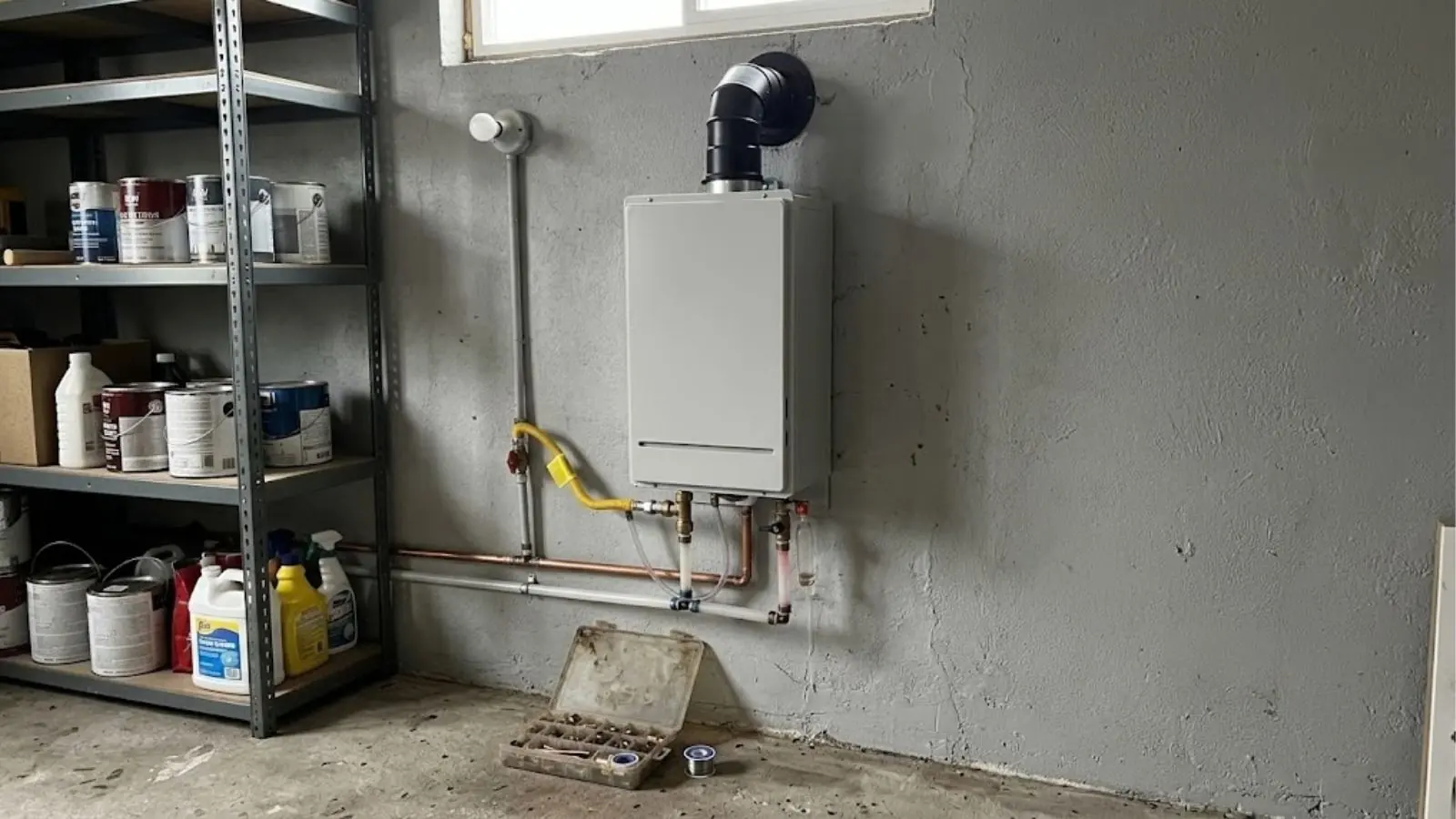
A gas tankless water heater works by heating water only when you ask for it. When you open a hot tap, a flow sensor detects the water moving, the control board lights a gas burner, and the cold water passes through a heat exchanger and leaves hot. Close the tap and the burner shuts off. There is no tank holding a stored supply.
That on-demand design is why these units are compact and why a household can run out of capacity if too many fixtures open at once. This guide follows the water and the gas step by step, then covers venting, gas line sizing, the cold water sandwich, and what to do when something smells wrong.
Gas piping and venting for tankless units follow manufacturer guidelines and the California Plumbing Code, which is based on the Uniform Plumbing Code (UPC).
Gas smell? Leave first, then call
If you smell gas near the heater or anywhere in the house, leave the building right away. Call 911 from outside, then call PG&E at 1-800-743-5000. Do not flip switches, strike a match, or use a flashlight inside.
Call a plumber only after the area is safe. We never promise gas response, and the utility and emergency crews come first.
The sequence from tap to hot water
Here is what happens each time you draw hot water.
- You open a hot faucet. Cold water enters the unit and spins a small turbine or paddle in the flow sensor.
- The control board confirms enough flow to fire. Most units need a minimum flow before they ignite.
- A fan pushes air into the combustion chamber while the gas valve opens and an igniter lights the burner.
- Hot combustion gases flow across the heat exchanger. Water running through its tubes absorbs the heat.
- A temperature sensor tells the board how much gas to burn so the outlet water holds your set temperature.
- The vent carries exhaust outdoors. When you close the tap, the burner and fan shut off.
Flow sensor and minimum flow
The flow sensor is the unit's trigger. If it sticks, clogs, or reads low, you get a tap that stays cold or a heater that cycles on and off. Debris from the inlet filter is a common culprit.
Minimum flow is the other half of the story. A trickle from a low-flow faucet may not trip the sensor, which is why some people report no hot water at the sink but plenty in the shower. Running a second fixture can sometimes bring the flow above the threshold.
Condensing versus non-condensing
Both types use the same basic burner and heat exchanger. The difference is how much heat they capture from exhaust.
| Feature | Non-condensing | Condensing |
|---|---|---|
| Heat captured | Single exchanger | Second exchanger recovers more. |
| Exhaust temperature | Hot | Cooler |
| Vent material | Stainless or metal. | Plastic is common. |
| Condensate drain | Not needed | Needed |
| Upfront price | Usually lower | Usually higher |
| Operating efficiency | Good | Higher |
Your gas company, installer, and manual decide which vent type is allowed. Always match the vent to the unit.
Venting and combustion air
Burning gas makes exhaust, and that exhaust has to leave the building. A tankless unit uses a sealed vent pipe, either through the wall or up through the roof. Condensing models often use plastic pipe because the exhaust is cooler, while non-condensing models need metal vent material.
Many units also pull combustion air from outside through a second pipe. Keeping both vent terminations clear of snow, nests, and shrubs matters, since a blocked vent can shut the unit down or cause carbon monoxide to build up. A working carbon monoxide alarm near the sleeping area is a sensible backup.
Gas line sizing and why it fails
A tankless heater can demand far more gas at once than a tank heater, because it heats water instantly. An older gas line sized for a tank unit may be too small, which causes ignition errors, low output, or shutdowns when other gas appliances run.
A plumber measures the length and diameter of the line and compares it to the unit's rating. Upsizing a gas line is real work, and it is one reason a tankless water heater swap is rarely just a unit exchange.
The cold water sandwich
You turn off the hot tap briefly, turn it back on, and get a burst of cold water. That is the cold water sandwich. Hot water left in the pipes cooled, the unit shut off, and the next flow pushed cold water ahead of fresh hot water.
It is a design quirk, not usually a defect. A recirculation loop or small buffer tank on the unit can soften it. Shorter runs between heater and fixture help too.
Check yourself or call
Try these safe checks before you reach for the phone. Stop and call if gas is involved.
- Confirm the gas valve and power switch are on, and the display shows no error code.
- Clean the inlet water filter following the manual.
- Make sure the vent terminations outside are not blocked.
- Check whether a pilot-style flame or a clicking igniter appears at startup.
- If you smell gas, do none of the above: leave and call 911 and PG&E.
- For anything else, a licensed plumber can diagnose the sensor, burner, and gas supply. See water heater repair for what that visit involves.
Lafayette note: gas safety source and permit rules
The gas safety steps above come from PG&E, and the utility's page on a gas leak says to leave, call 9-1-1, and avoid ignition sources. It also says PG&E restores service after gas is shut off. So if your heater area ever smells off, treat it as a leave-first situation, not a plumbing fix.
The City of Lafayette permit page lists plumbing and mechanical permits for water heater repair, replacement or installation at single-family homes as exempt from a building permit. That exemption does not mean gas and venting are optional, so ask the Lafayette building department about gas and venting before you start work.
Digging near buried lines for a new gas run needs a call to 811 first. If you are comparing options with neighbors in Orinda or Pleasant Hill, the same advice applies: ask your own city building department.
Gas tankless questions from Lafayette homeowners
When you open a hot tap, a flow sensor tells the unit to fire a gas burner. Cold water runs through a heat exchanger, picks up heat, and leaves as hot water.
When you close the tap, the burner shuts off.
It burns a lot of gas quickly to heat water on demand. A line sized for a tank heater may not deliver enough for a tankless unit.
A plumber checks line length and size against the unit's rating.
That is the cold water sandwich. Cooled water in the pipes and the unit's restart delay create a brief cold burst.
A recirculation setup or a short pipe run can reduce it.
Most need electricity for the fan, control board, and igniter, so they stop working when power is out.
A battery backup or generator can keep one running, but check your manual.
The City of Lafayette lists water heater repair, replacement or installation at single-family homes as exempt from a building permit.
Because gas and venting are involved, ask the Lafayette building department before work begins.
Leave the building, call 911, and then call PG&E at 1-800-743-5000. Do not use switches or flames.
Call us only after it is safe. Our licensed plumbers can repair the cause once the utility clears the area.
Still unsure what you are dealing with? Call the 24/7 line and describe it to a dispatcher.
Call (855) 575-2890