
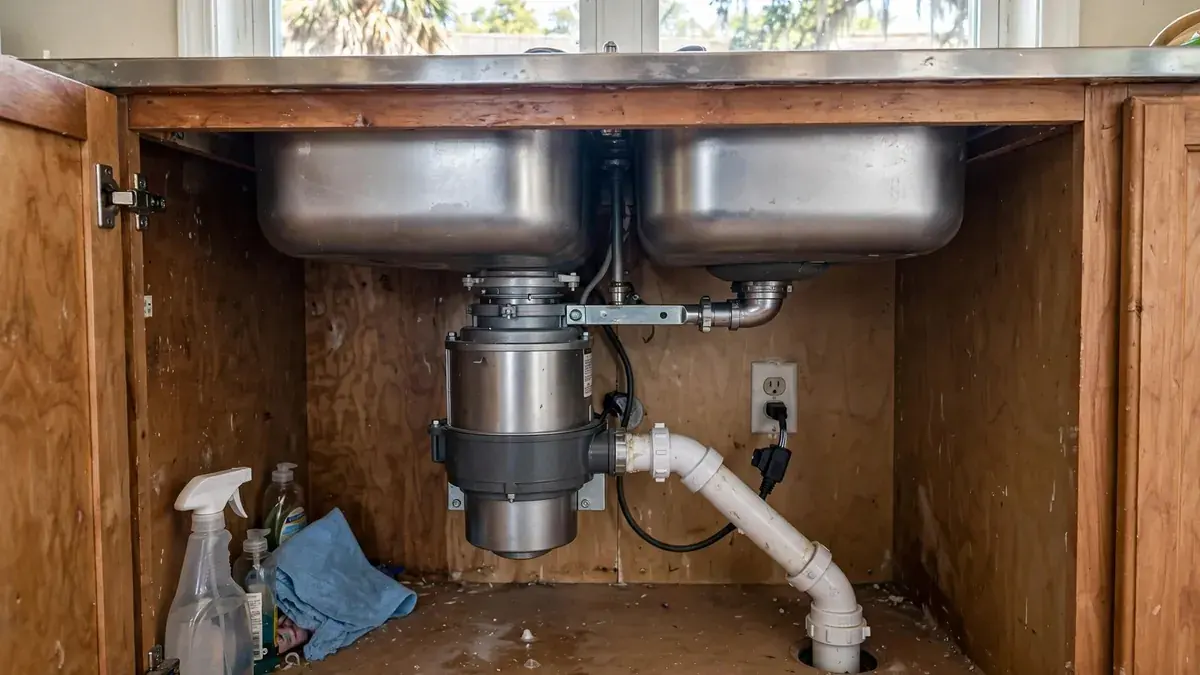
Kitchen garbage disposal installation comes down to five tasks: mount the new unit under the sink flange, connect power, open the dishwasher knockout if you have a dishwasher, line up the drain, and test for leaks. Replacing an old disposal is a common weekend job. Adding one where none exists takes more planning.
This guide is for Lafayette homeowners who want to know what the work involves, what tools to gather, and where the line sits between DIY and a call. The electrical side is the part that deserves the most respect.
Read through once before buying a unit. The right horsepower, mount type and power setup save a second trip to the store. The drain connection and air gap rules come from the California Plumbing Code, which is based on the Uniform Plumbing Code (UPC), and the electrical hookup follows the National Electrical Code (NEC).
Pick the right disposal before you start
Horsepower and feed type decide how well the unit handles scraps and how loud it runs.
| Type | Best for | Trade-off |
|---|---|---|
| 1/3 horsepower | Light use, one or two people. | Jams on tougher scraps. |
| 1/2 horsepower | Typical family kitchen. | Good balance of price and power. |
| 3/4 horsepower | Frequent cooking | Heavier and louder. |
| 1 horsepower | Heavy use, bigger households. | Needs strong sink support. |
| Batch feed | Households with kids. | Runs only with the lid in place. |
| Continuous feed | Most kitchens | Switch controls the motor. |
Most households do fine with a half or three-quarter horsepower unit. Bigger is not always better if your drain line is old.
Tools and materials checklist
Gather everything before you shut off power:
- A screwdriver set, adjustable pliers, and a hammer or mallet for the dishwasher knockout.
- Plumber's putty and the mounting hardware that comes with the unit.
- A power cord kit or wire nuts, depending on how the unit is powered.
- A new trap arm and drain fittings if the old ones are corroded or misaligned.
- A bucket, towels, a flashlight, and safety glasses.
Electrical: cord, hardwire, and the switch
Disposals are powered either by a plug-in cord into an under-sink outlet or by hardwiring to a junction box. Check your unit's instructions and the wiring already under your sink. Do not guess.
Turn off the circuit at the breaker, since the wall switch alone does not isolate the wiring. Test the wires with a non-contact voltage tester before touching anything. If there is no outlet or switch, adding one is electrical work, which needs a licensed electrician in California.
Plug-in setups use a grounded outlet, often on a switched circuit. Hardwired units connect black to black, white to white, and green to ground inside the cover plate. Never run the unit dry or with the cord pinched in the cabinet door.
Install the disposal step by step
The sequence is the same for most mount types. Check your model's manual for specifics.
- Shut off power at the breaker and confirm with a tester. Close the sink supply valves if you are working near them.
- Remove the old unit, disconnect the drain trap, and unscrew the mounting ring to free the sink flange.
- Clean the sink opening. Roll plumber's putty into a rope, press it under the new flange lip, and seat the flange in the drain hole.
- From below, slide on the gasket, backup ring and mounting ring, then tighten the mounting screws evenly until the flange is snug.
- If you have a dishwasher, knock out the plug inside the dishwasher inlet with a screwdriver and hammer. Fish out the plug so it does not block the drain later.
- Hang the disposal on the mounting ring, twist until it locks, and connect the dishwasher hose with its clamp.
- Wire the unit, then line up the discharge outlet with the trap arm and tighten the drain connection.
The dishwasher knockout, in plain words
New disposals have a small plastic plug inside the dishwasher inlet. If a dishwasher connects, that plug must be removed. If you skip it, the dishwasher will not drain and water will back up in the machine.
Knock it out from inside the disposal body, then pick the plug out of the chamber. A dropped plug can jam the blades or sit in the trap. The dishwasher drain hose should also loop high under the countertop before it meets the inlet, which helps stop dirty water flowing back into the machine.
Drain alignment and the leak test
The most common installation problem is a drain that does not line up. The discharge pipe sits at a fixed height, and the trap arm has to slope slightly downhill toward the wall. If it slopes the wrong way or sags, water pools and slow draining follows.
Hand-tighten the slip nuts first, then check alignment before the final snug. When it looks right, fill the sink with a few inches of water, then pull the stopper and watch every joint with a dry paper towel.
Run the disposal with cold water for thirty seconds and test again. Check the mounting ring, the dishwasher hose and the trap for beads of water.
When to call a plumber instead
A licensed plumber is the better choice in these cases:
- There is no outlet or switch under the sink and wiring must be added.
- The sink drain, trap arm or wall stub is corroded, cracked, or leaking before you start.
- You have a double bowl or an unusual sink that needs a different flange or drain kit.
- The unit hums and does not spin after you have reset it, or trips the breaker.
- Water has soaked the cabinet base or reached nearby wiring.
What affects the price
A straight swap on a sink that is already set up is the simplest job. Cost grows when the plumber must add an outlet, replace a failing trap arm, fit a new sink flange, or work around a poorly placed dishwasher connection.
The unit itself also matters, since horsepower, noise insulation and warranty differ from model to model. Many homeowner policies cover sudden water damage but not slow leaks or the failed part itself, so read your policy and ask your insurer.
Our garbage disposal service covers new installs and replacements, and a worn trap arm falls under drain cleaning and repair. Call for a clear price before work starts.
Lafayette note: what goes down the drain ends up in your lateral
In Lafayette, the property owner owns the whole sewer lateral from the house to the Central San main, including the section under the sidewalk or street. A disposal sends ground food waste into that lateral, so what you feed it is your maintenance responsibility.
Central San reports that root intrusion is the leading cause of sewer backups, and grease and food solids give roots and blockages a place to catch. Keep fats, oils, coffee grounds, and stringy or starchy scraps out of the disposal, and run cold water for a bit after use.
Read the Central San home guide and locate your cleanout. If you have a history of slow kitchen drains, mention it when you call so we can check the line as well as the unit.
Disposal installation questions in Lafayette
A straight replacement typically takes a couple of hours. A first-time install, with new wiring or drain work, takes longer. The dishwasher knockout and drain alignment are the steps that eat time.
Only if there is no outlet or switch and wiring has to be added. If power already exists under the sink, a plumber or careful homeowner can connect the unit.
A half to three-quarter horsepower unit suits most family kitchens. Go bigger only if you cook a lot and your drain line is in good shape.
It will not harm the pipe directly, but grease and food solids can build up and help roots and blockages form. The owner maintains the lateral to the Central San main, so keep fats and fibrous scraps out.
Yes. We install and replace disposals for homes in Lafayette, Orinda and Walnut Creek, with same-day appointments when available. Call for a clear price before work starts.
Still unsure what you are dealing with? Call the 24/7 line and describe it to a dispatcher.
Call (855) 575-2890