
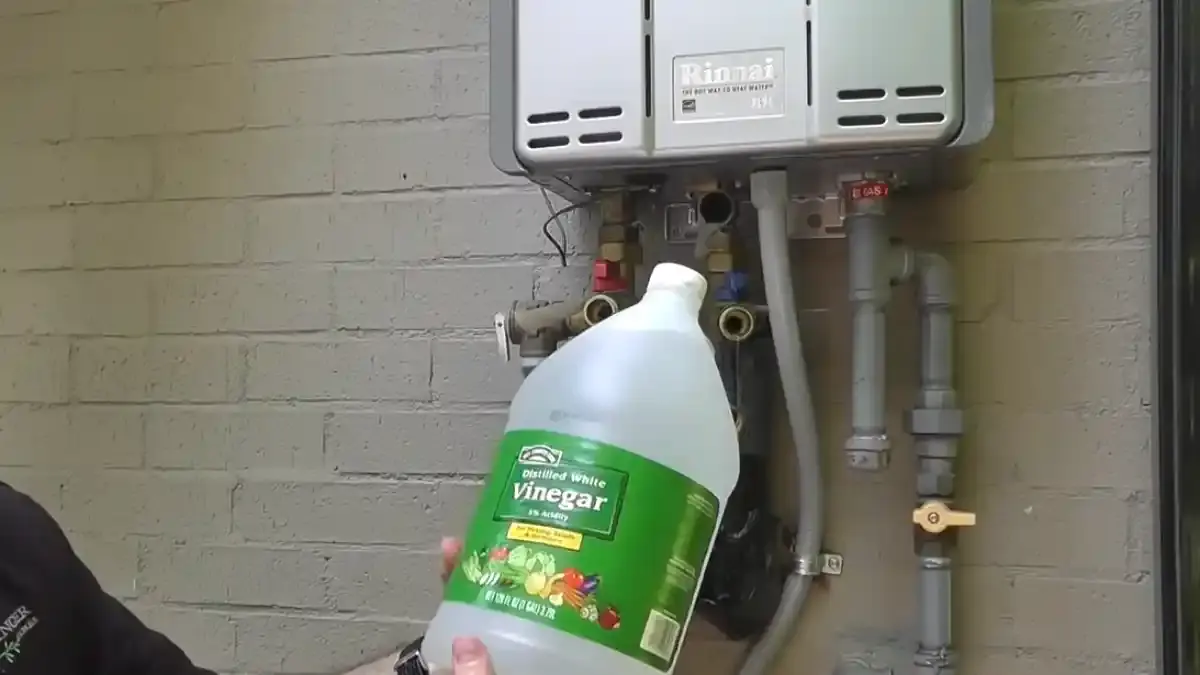
To flush out a tankless water heater, you circulate a descaling solution through the heat exchanger with a small submersible pump, then rinse with clean water. Most manufacturers accept food-grade white vinegar, and some require their own approved solution. The loop runs about 45 minutes to an hour, and the job needs service valves on the unit.
Flushing clears mineral buildup and sediment that slow heat transfer and trigger error codes. The steps below cover the setup, the circulation, the rinse, and the filter cleanup, then explain when to stop and call a licensed plumber. Follow the manufacturer's maintenance guidelines for your exact model, because they set the flush interval and the solution allowed.
What you need before you start
Gather these before you shut anything off. Most of it fits in a bucket.
- A small submersible utility pump rated for flushing.
- Two washing machine or garden hoses with female ends.
- A 5-gallon bucket.
- About 2 to 3 gallons of food-grade white vinegar, or your manufacturer's approved descaler.
- Towels and a way to read your unit's display.
- The owner's manual, since some brands specify solution strength or contact time.
Flushing step by step
Read the unit's manual alongside this list. If anything conflicts, follow the manual.
- Switch off the unit and unplug it. Close the gas shutoff valve.
- Close the cold and hot isolation valves, then open the drain ports slightly to relieve pressure and let a little water out.
- Connect one hose from the pump to the cold service port and a second hose from the hot service port back into the bucket.
- Pour the vinegar or approved solution into the bucket. Open both service ports fully.
- Run the pump so the solution circulates from the bucket, through the heat exchanger, and back to the bucket.
- Let it circulate for the time the manual gives. If you have no guidance, 45 minutes to an hour is a common range.
- Turn off the pump, close the service ports, disconnect the hoses, and drain the bucket.
- Open the cold inlet valve with the hot outlet hose draining to the bucket and rinse with clean water until the water runs clear.
- Reconnect everything, open the hot valve, restore gas and power, and run hot water to confirm normal operation.
Why vinegar works and when it does not
White vinegar is mildly acidic, so it dissolves calcium and magnesium scale without attacking stainless steel. It is cheap, readily found, and safe to pour down a drain after rinsing. That makes it the common choice.
Some manufacturers prefer a branded descaler or limit what you can use, so check the manual before pouring anything in. Never mix vinegar with bleach or other cleaners.
Do not skip the inlet filter
Each tankless unit has a small screen at the cold water inlet. It catches sand, rust flakes, and scale bits before they reach the heat exchanger. A clogged screen reduces flow and can set off a fault.
Pull the screen out with the isolation valves closed, rinse it under the tap, scrub gently with a soft brush, and slide it back in. Then check the washer so it seats evenly. It takes a few minutes, and many flow problems end right there.
Error codes that suggest a flush
Codes vary by brand, so use this as a pattern, not a diagnosis.
| Symptom | Possible cause | Next step |
|---|---|---|
| Water barely warm. | Scale on exchanger. | Flush with descaler. |
| Flow error code. | Clogged inlet screen. | Clean the filter. |
| Temperature or overheat code. | Limited flow through exchanger. | Flush, then retest. |
| Unit cycles on and off. | Low flow or sediment. | Flush and check flow. |
| Ignition error | Gas or vent issue. | Do not flush, call a plumber. |
| Leak at a fitting. | Failed seal or valve. | Call a plumber. |
A code that returns after a clean flush is the signal to stop and bring in a technician.
Mistakes that cause trouble mid-flush
The most common slip is leaving the power on. A pump circulating vinegar through a unit that can still fire is asking for a damaged board or a dry-fire. Unplug the unit and close the gas before you connect a single hose.
The second is a hose that pops off the service port. Hand-tighten the fittings, set the bucket low so gravity helps, and watch the first minute of circulation for drips. A damp towel under each port makes leaks easy to spot.
The third is rinsing too little. Leftover vinegar can leave a sour taste in the first glass of hot water. Rinse until the water runs clear and odorless, then run a hot faucet for a minute before using it.
Last, write the date on your manual or a note near the unit. A service record helps you follow the manufacturer's schedule and shows a warranty reviewer that you kept up with it.
When to call a plumber instead
Call a licensed plumber if you smell gas, see soot or scorching at the vent, find water around the unit, or cannot get the isolation valves to turn. Forcing a seized valve can crack a fitting and make a small chore into a repair.
If you smell gas, leave the building, call 911, and then call PG&E before you phone us. For anything else, water heater repair covers diagnosing the sensor, board, and burner.
What a professional flush adds
A plumber brings a proper pump, flushes both directions, tests output, and inspects the vent, burner, and gas connections. We can also add isolation valves if your unit lacks them, which makes every later flush simple.
Price depends on access, whether valves are already installed, and the condition of the unit. Call for a clear price before work starts. If the heater is failing for other reasons, we can also talk through water heater replacement.
Lafayette note: very soft water, slow scale
EBMUD reports hardness of 16 mg/L at the Lafayette treatment plant, about 0.9 grains per gallon. That is very soft water, so scale builds slowly in a heat exchanger here compared with hard-water areas. Most Lafayette homeowners are flushing for sediment, not heavy mineral crust.
An annual check is still sensible. The manufacturer's schedule rules, and your warranty may depend on it, so keep service records. If your unit gives a flow or temperature code, flush and clean the screen first.
You can confirm current water numbers in the EBMUD water quality report. Homes in Moraga or Walnut Creek should check their own water report, since conditions differ.
Flushing questions we hear around Lafayette
Follow your manufacturer's schedule. Lafayette water from EBMUD is very soft, so scale is slow, but an annual check is still sensible.
Flush sooner if you see flow or temperature codes.
Food-grade white vinegar is accepted by many manufacturers because it dissolves scale without harming stainless steel.
Some brands require their own solution, so read the manual first.
The circulation step usually runs 45 minutes to an hour. Add time for setup, rinsing, and cleaning the inlet filter.
Plan about two hours for a first-time flush.
Not easily. You need ports to connect the pump and hoses.
A plumber can install valves so you can flush it yourself later.
Reset it once and run hot water. If the code returns, the cause may be the flow sensor, the burner, or a gas or vent problem.
That is the point to call a licensed plumber.
Yes. Our licensed and insured plumbers can flush your unit, clean the screen, and check the vent and gas connections.
Call for a clear price before work starts, and ask about same-day appointments when available.
Still unsure what you are dealing with? Call the 24/7 line and describe it to a dispatcher.
Call (855) 575-2890