
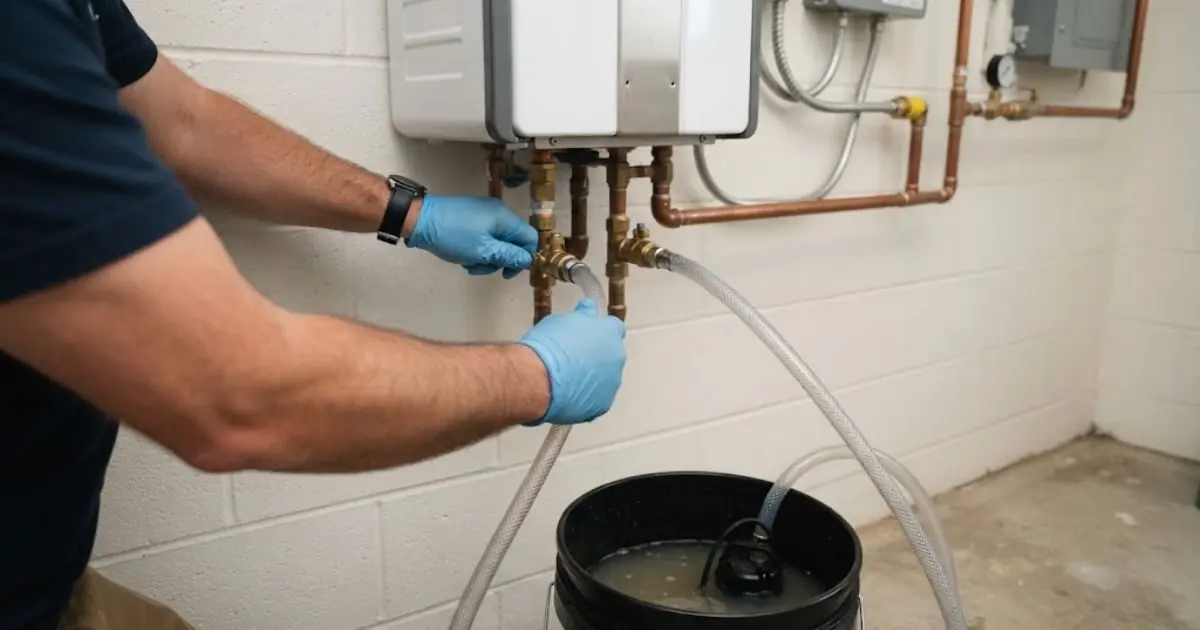
Draining a tankless water heater means shutting off its gas or power, closing the water, and letting the heat exchanger and connected lines empty through the service valves. Most homeowners with isolation valves installed can do it in under an hour with a hose and a bucket. Without those valves, the job gets harder and is usually better left to a plumber.
You would drain a unit for a long vacation in a cold snap, before removing it for repair, or to flush out sediment. This guide covers each reason, the tools, the full sequence, and how to refill without trapping air. It is written for Lafayette homes, but your unit's manual always wins over any general guide.
Always follow the manufacturer's guidelines for your model, and leave gas, vent and relief valve work to licensed plumbers working to the California Plumbing Code, which is based on the Uniform Plumbing Code (UPC).
Four reasons to drain the unit
The most common reason is a flush, where you drain the heater and circulate a cleaning solution through it. A separate guide covers that process, so here we focus on a plain drain. Plain draining is the right move when the unit is coming out for replacement, when a part is being serviced, or when the house will sit empty.
Freeze risk is the reason people worry about most. A unit with built-in freeze protection survives a cold night only while it has power, so a long outage or an unplugged unit changes the picture. If you leave for weeks and the home will not be heated, draining removes the risk entirely.
Service visits are the fourth reason. A plumber may drain the heat exchanger before swapping a flow sensor or a water inlet filter. Knowing the steps lets you follow along and ask good questions.
Parts and tools to gather first
Set everything within arm's reach before you touch a valve. Hunting for a bucket with hot water running is how floors get wet.
- Two garden hoses or washing machine hoses, one for each service port.
- A 5-gallon bucket or a floor drain nearby.
- A flat screwdriver or the valve key from your manual.
- Towels and a flashlight (use a battery light, never a flame, near a gas appliance)
- Your unit's manual or model number for the exact valve layout.
- Gloves, because the first water out can still be hot.
Isolation valves and why they matter
Service valves are a pair of fittings on the cold inlet and hot outlet, each with a small drain port and a cap. They let you shut off the heater from the house plumbing and flush or drain it alone. Many installers add them, but some units go in without, and the manual will not help if they are missing.
If your unit lacks them, a plumber can add a set. That is a small job during any service call on a tankless water heater, and it makes every later drain or flush simple.
Draining step by step
Follow the order below. Skipping the power and gas steps is the one mistake that can hurt someone or burn out a part.
- Turn the unit off at its control panel, then unplug it or switch off its dedicated circuit so the electronics cannot fire.
- Close the gas shutoff valve on the line to the heater. Handle gas only as far as the manual describes.
- Close the cold water inlet isolation valve and the hot outlet isolation valve. If you have no isolation valves, close the main shutoff to the house instead.
- Open a hot faucet somewhere in the house to let air in, so the lines can drain freely.
- Attach a hose to each drain port, run the free ends to the bucket or floor drain, and open the ports. Water will run until the heat exchanger is empty.
- Let it drip until it stops. Some units hold a little water in low points, so leave the ports open for a few minutes.
- Close the ports, remove the hoses, and screw the caps back on hand tight.
If the water is cloudy or gritty, that is sediment or a failing filter, and it is worth a flush before you close everything up.
Refilling and purging air
Open the cold inlet valve first, with the hot faucet in the house still open. Water should fill the heat exchanger and push air out through that faucet, often with sputtering. Keep the faucet open until the flow runs smooth and steady.
Then open the hot outlet valve and check both service ports and every cap for drips. Only after the unit is full should you restore power and open the gas valve. Firing a tankless heater dry can damage the heat exchanger quickly, so never skip the fill.
Run hot water at a fixture for a minute and watch the display. If an error code shows, reset the unit once and see whether it clears. A code that comes right back points to trapped air or a blocked filter.
Gas and power safety rules
If you ever smell gas near the heater, leave the building, call 911, then call PG&E at 1-800-743-5000. Do not use a lighter, a match, or a switch before you go. PG&E's guidance on what to do during a gas leak says to avoid ignition sources and call from outside.
Never test for leaks with a flame. A gas line that has been shut off should be restored by PG&E, not by you.
Do it yourself or call a plumber
The line between a safe weekend job and a call is mostly about valves, venting, and gas.
| Situation | DIY reasonable? | Why |
|---|---|---|
| Valves installed, electric or simple gas unit. | Usually yes | Hoses and a bucket are enough. |
| No isolation valves. | Call a plumber. | Draining means cutting into the lines. |
| Gas smell or soot at the vent. | No | Leave, call 911 and PG&E first. |
| Valves seized or leaking. | Call a plumber. | Forcing them can crack a fitting. |
| Unit is condensing with a drain trap. | Maybe | Trap and neutralizer need care. |
| Error code after refill. | Try one reset. | Repeated codes need a technician. |
For anything involving a gas line or a vent, call licensed plumbers. We can add valves, drain the unit, and refill it correctly. Call for a clear price before work starts.
What this costs when you hire it out
A plain drain with valves already installed is a short visit. Adding valves, reaching a unit in a tight closet or attic, and working around corroded fittings all add time. A condensing unit may also need its drain trap checked.
If the drain is part of a repair or water heater repair, the labor often folds into that visit. Call for a clear price before work starts so you are not guessing.
Lafayette note: very soft water and your service schedule
EBMUD reports hardness of 16 mg/L at the Lafayette treatment plant, about 0.9 grains per gallon. That is very soft water, so mineral scale builds slowly in a heat exchanger here. In practice, you will see sediment and filter debris more often than hard scale, and a drain-and-flush interval can lean on the longer end of your manufacturer's schedule.
Soft water does not make the manual optional. The manufacturer's interval is what protects your warranty, so follow it, and use the EBMUD water quality report to confirm current numbers for your area.
Lafayette is also home to many hillside lots where heaters sit in garages or crawl spaces. Pick a drain point you can reach safely, and if neighbors in Orinda or Moraga ask about the same process, the answer is the same: valves first.
Draining questions Lafayette homeowners ask
With isolation valves in place, set aside a relaxed hour for setup and cleanup. Draining itself is quick because a tankless unit holds only a small amount of water.
Refilling and checking for leaks adds time, so do not rush the last steps.
Usually not. Lafayette has a Mediterranean climate with dry summers and wet winters, and units with built-in freeze protection handle normal nights as long as they stay powered.
Drain only if the house will be empty and unheated for an extended stretch, or if your manual says so.
It is possible but awkward. You would shut the main, open the lowest fixture, and break fittings to release the water.
That is a plumber's job. We can install valves while we are there so you never need to do it the hard way again.
Air trapped in the heat exchanger and lines will sputter out as the pipes fill. Keep a hot faucet open until the flow is steady.
If sputtering keeps up for several minutes, shut the unit off and check the inlet filter.
Yes. A tank unit holds dozens of gallons and drains from one spigot at the bottom. A tankless unit drains through two service ports and holds only a small amount of water.
Shutting off gas and power first applies to both.
If you have never done it, a first visit helps. Our licensed plumbers can show you the valve layout and confirm everything is tight.
Call for a clear price before work starts, and ask about same-day appointments when available.
Still unsure what you are dealing with? Call the 24/7 line and describe it to a dispatcher.
Call (855) 575-2890