
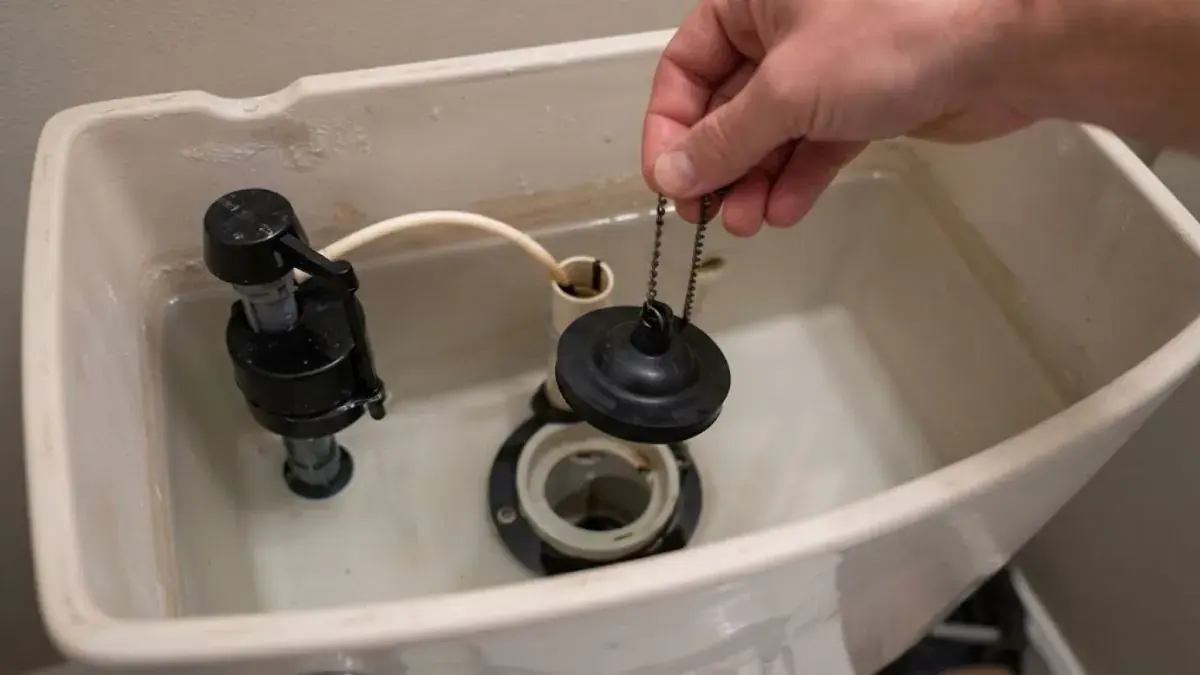
To install a toilet float valve, you shut off the supply, drain the tank, remove the old valve and supply line connection, set the new valve at the correct height, reconnect the line, and adjust the water level. Most homeowners finish in under an hour.
The terms confuse people. The older ball-and-arm float valve and the newer fill valve do the same job, which is to refill the tank and shut off at the right level. Modern kits are cheaper and easier, so this guide covers swapping to a fill valve in a Lafayette home.
Read the whole page before you start. Knowing the stopping points will save you a flooded bathroom. Fill valves must meet the anti-siphon standards in the California Plumbing Code, which is based on the Uniform Plumbing Code (UPC), so buy a replacement rated for your tank.
Is it the fill valve, or the flapper?
A toilet that hisses, refills on its own, or runs continuously has either a bad fill valve or a leaking flapper. They look alike from the outside, so check before you buy parts.
Drop a few drops of food coloring in the tank and wait fifteen minutes without flushing. If color shows in the bowl, the flapper is leaking. If the tank water rises up to the overflow tube and keeps running, the fill valve is not shutting off.
Often both are old. If your flapper is soft, warped or slimy, replace it while the tank is empty.
Tools and parts to gather
Everything fits in a small bucket. Gather it before you shut off the water:
- A universal fill valve kit with the correct height range for your tank.
- A new braided supply line if the old one is crusty, kinked, or more than a few years old.
- An adjustable wrench or channel-lock pliers.
- A sponge, a small bucket, and old towels.
- A new flapper if the old one failed the dye test.
Match the valve to your tank. A fill valve that sits too tall will hit the lid, and one that sits too low will not shut off at the right level.
Replace the fill valve step by step
Work slowly and keep towels under the fittings.
- Close the shutoff valve at the wall by turning it clockwise. Flush to empty the tank, then sponge out the last inch of water.
- Unscrew the supply line nut from the bottom of the old valve. A little water will drip out, so keep the bucket close.
- Loosen the locknut under the tank that holds the valve. Lift the old valve straight out.
- Set the new valve in the tank hole. Adjust its height to the mark in the instructions, then hand-tighten the locknut from below.
- Reconnect the supply line, snug by hand, then a quarter turn with a wrench. Over-tightening plastic threads cracks them.
- Attach the small refill tube to the overflow pipe, with its end above the water line, not pushed into the pipe.
- Turn the water on slowly. Look under the tank for drips while it fills.
Set the water level and test
Most tanks have a fill line marked inside, or the water should stop about an inch below the top of the overflow tube. Turn the adjustment screw or slide the float clip until the level matches.
Flush a few times and watch the tank. It should refill quietly and stop without a trickle. If the fill valve shuts off but the water level slowly drops, the flapper is leaking.
Finish by wiping every joint with a dry paper towel. A damp towel shows a slow drip that you might miss by eye.
Float valve or fill valve: which type fits
You do not have to keep the old style. Compare the options before you buy.
| Type | How it works | Good for |
|---|---|---|
| Ball float (old style) | Metal arm and ball rise with water. | Repairing very old tanks. |
| Cup float fill valve. | Cup slides up the valve shaft. | Most replacements |
| Floatless pressure valve. | Senses water pressure, no float. | Tight tanks, quiet fill. |
| Adjustable height kit. | Fits a range of tank sizes. | Unknown tank model. |
Whichever type you pick, make sure it states it meets plumbing code for backflow protection.
When to stop and call a plumber
This is a manageable repair, but some situations call for a licensed plumber.
- The shutoff valve at the wall will not close fully or leaks when you turn it.
- The tank is cracked or the porcelain bolts and nuts are badly rusted.
- Water seeps out at the base of the toilet, which points to a wax ring or flange problem.
- The supply line is corroded to the shutoff valve and will not come off.
- Water is already on the floor and running toward an electrical outlet.
What a plumber charges for: the price factors
A plumber replacing a fill valve is doing a small job, but price depends on what else is found. A seized shutoff valve, a cracked supply line, or a worn flapper all add parts and time.
Access matters, too. A hidden leak check is worth asking about if the bowl refills on its own. A toilet with a tight corner or a concealed shutoff takes longer. Many homeowner policies cover sudden water damage but not slow leaks or the failed part itself, so read your policy and ask your insurer.
If you want a hand, toilet repair covers fill valves, flappers and wax rings. Call for a clear price before work starts.
Lafayette note: EBMUD water and rubber parts
EBMUD supplies Lafayette, and its treatment plant water is very soft at 16 mg/L of hardness, with a pH around 9.0 and about 2.6 mg/L of chloramine. Soft water means little mineral scale on fill valves, so a sticky float is more often worn rubber than crust.
Chloramine is a disinfectant that can be harder on some rubber parts over time. As a general statement, flappers and seals in chloraminated water may wear faster, so check them on a schedule, such as when you clean the tank or once or twice a year, instead of waiting for a leak.
The numbers come from the EBMUD water quality report. If you live next door in Moraga or Pleasant Hill, ask your own water utility for its report before assuming the same chemistry.
Float valve questions from Lafayette homes
A float valve is the older design with a ball on an arm. A fill valve is the modern cup or pressure type. Both stop the tank at the right water level, and a fill valve is easier to install and adjust.
Most homeowners finish in one sitting once the parts are in hand. Plan extra time if the shutoff valve is stiff or the supply line needs to be replaced as well.
Check the water level first, since it may be too high and spilling into the overflow tube. If the level is right, the flapper is probably leaking into the bowl.
EBMUD water in Lafayette is very soft, so mineral scale is low. It also uses chloramine, and rubber parts such as flappers may wear faster in chloraminated water, so check them on a schedule.
Yes. We handle fill valves, flappers, supply lines and shutoff valves, with same-day appointments when available. Call and we will give a clear price before work starts.
Still unsure what you are dealing with? Call the 24/7 line and describe it to a dispatcher.
Call (855) 575-2890